

ABM data enrichment is the process of layering four specific data types onto target account records: firmographics, technographics, buying committee contacts, and intent signals. Each layer serves a different function. Together, they convert a flat account list into a working operational map.
Account-based marketing collapses without accurate data. The strategy demands that you know exactly who sits inside a target account, what technology they run, and whether they are actively shopping.
Most ABM programs carry none of that. They hold company names, a handful of contacts, and firmographic basics that were already going stale the day they entered the CRM.
What Data Does ABM Enrichment Add?
ABM enrichment adds four data layers, each solving a different gap in account intelligence. Firmographics anchor account selection. Technographics shape positioning. Buying committee data enables multi-threaded execution. Intent signals determine timing. None of these layers is optional; pulling any one of them removes the ability to execute a core part of the ABM motion.
Firmographics cover company-level attributes: employee count, revenue range, industry vertical, growth stage, headquarters location, and org structure. These are your account selection inputs. Without accurate firmographics, your ICP filters produce thousands of technically matching companies, most of which do not deserve the spend. Firmographic data also decays faster than most teams realize. B2B contact databases lose accuracy at a rate of 22.5% annually, and company-level attributes shift alongside headcount changes, acquisitions, and rebrands.
Technographics reveal what technology stack a target account currently runs. That single dataset determines your entire positioning approach. An account running a direct competitor calls for displacement messaging. A complementary tool suggests an integration pitch. Legacy infrastructure signals a modernization opportunity. Without this layer, teams default to generic messaging that lands nowhere because it addresses nobody specifically.
Buying committee contacts are where most ABM programs hit a wall. According to Forrester's 2024 State of Business Buying Report, the average B2B purchase involves 13 stakeholders. Running single-threaded outreach into an account with a 13-person buying committee is not ABM. It is a lottery. Enrichment maps the full committee: economic buyers, technical evaluators, champions, end users, and blockers, each with verified direct contact data.
Intent signals tell you who is shopping now. First-party signals come from your own properties: website visits, content downloads, pricing page activity. Third-party signals surface accounts researching your category across publisher networks, review platforms, and competitor sites. Without intent data, you spend the same budget on accounts ready to buy this quarter and accounts that will not move for a year. The distribution of effort is identical. The results are not.
Why Account-Based Programs Stall Without Enrichment?
The failure mode in ABM is usually invisible until spend has accumulated. Campaigns launch. Engagement stays low. Sales says the leads are not ready. Marketing says the accounts fit. Both are right, and neither is looking at the actual data problem underneath. Three specific breakdowns account for most ABM underperformance.
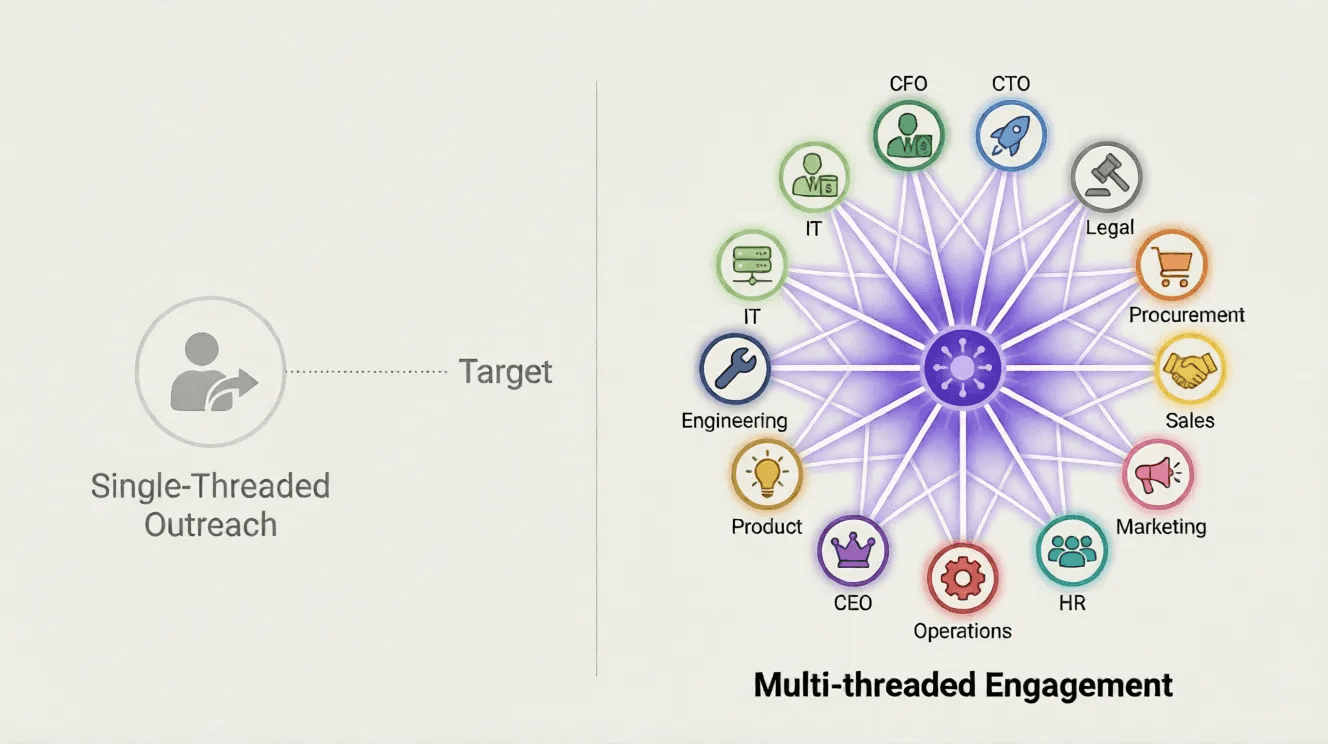
Buying committee blindness is the most common. A single contact in an account with 13 decision-makers means 92% of the committee never sees your campaign. Multi-threaded engagement, reaching three or more stakeholders in parallel, closes deals at two to three times the rate of single-contact outreach. Enrichment solves this by mapping the full organizational chart and supplying verified contact data for each stakeholder role.
Poor timing is the second failure mode. At any given time, only 5% of B2B accounts are actively evaluating a purchase. Treating the other 95% with the same urgency drains budget and fatigues sales. Intent data creates a clear separation between in-market accounts that deserve immediate attention and accounts that need low-touch nurture until signals shift.
Generic personalization is the third. Personalization without intelligence is surface-level. Referencing an account's industry in an email subject line is not personalization; it is a mail merge. Real personalization requires knowing the technology they run, the business context they are operating in, and the specific pain point that applies to each stakeholder's role. Enrichment provides all of that at the account level, not the individual contact level.
How ABM Data Enrichment Works?
ABM enrichment runs through three sequential phases: account prioritization, data layering, and activation. The first phase determines where to apply resources. The second builds the account profiles needed to execute. The third puts that intelligence to work across the ABM motion. Each phase depends on the one before it.
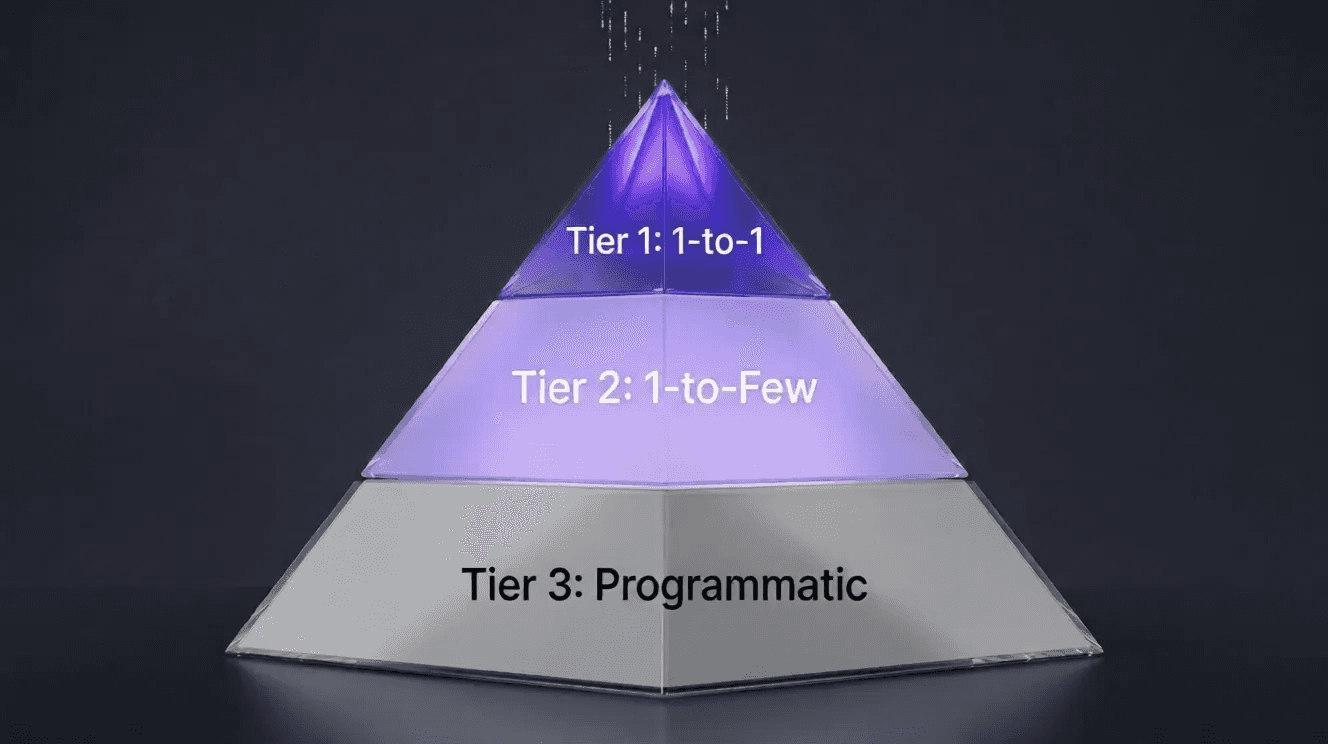
Account prioritization starts with the ICP criteria that marketing and sales have agreed on, then applies enrichment signals to rank order. The underlying logic is that not all ICP-matching accounts deserve the same resources. Companies with strong ABM programs attribute 79% of all pipeline opportunities to ABM efforts, but those results come from concentration, not distribution. Enrichment enables that concentration by separating accounts into tiers: high ICP fit with strong intent signals go to Tier 1 personalized campaigns; good fit with moderate signals drop to programmatic; profile matches with no activity stay in low-touch nurture.
Data layering appends firmographics, technographics, buying committee contacts, and intent signals to each account record through API connections or scheduled batch processes. The enrichment provider matches account identifiers (company domain, LinkedIn URL, or company name plus location) against its database and returns the available attributes. What happens next is where most implementations fail. Field mapping rules determine which enriched attributes land in which CRM fields, and overwrite logic protects manually verified data from being replaced by automated enrichment. This configuration step determines whether the enrichment actually becomes usable.
Activation is where enriched data earns its cost. Firmographics feed segmentation and account scoring models. Technographics route accounts into positioning tracks. Buying committee contacts flow into sales engagement sequences and multi-threaded campaign workflows. Intent signals trigger alerts that push in-market accounts to active sales attention. ABM can reduce time spent on unproductive prospecting by 50%, but only when the underlying data quality supports precise targeting. Without enrichment, that time reduction does not materialize.
This is distinct from lead enrichment, which fills missing fields on individual contact records. ABM enrichment builds organizational intelligence: who the stakeholders are, what they use, and when they are ready to engage.
The Four Use Cases That Drive ABM Pipeline
ABM enrichment produces measurable results in four specific scenarios. Each one represents a gap that incomplete data creates and that enrichment closes.
Target list qualification is the entry point. Starting from a broad ICP-matching universe of thousands of companies, technographic filters reduce that set to accounts running relevant technology. Intent data reduces it further to accounts showing active research. Buying committee verification confirms you can actually reach the right people. The result is a short, qualified list where every account justifies campaign investment.
Multi-threaded buying committee engagement is where enrichment creates the clearest advantage. With the full stakeholder map and verified contact data for each role, sales and marketing can run coordinated, role-specific campaigns in parallel. The CFO receives financial justification materials. Technical evaluators get architecture documentation. Department heads see workflow impact cases. Gartner research shows that ABM increases pipeline conversion rates by 14% and raises the MQL-to-sales-accepted lead rate by 25%, and multi-threading is a primary mechanism behind both improvements.
Competitive displacement depends almost entirely on technographic data. Without knowing that an account runs a competitor's platform, displacement campaigns are generic. With it, messaging can address the specific limitations of their current tool, the disruption cost of switching, and the integration path forward. Layering intent signals on top identifies which competitive installs are actively evaluating alternatives now versus those locked in for the near term.
Customer expansion applies enrichment to the existing account base. Mapping additional business units within an account surfaces new buying centers. Identifying technology gaps in their current stack reveals upsell opportunities. Intent signals for new use cases indicate which accounts are ready for an expansion conversation before the customer success team would naturally surface them. Companies using ABM see a 16% increase in customer retention and a 171% increase in average deal size.
Common ABM Enrichment Mistakes
ABM teams consistently repeat the same enrichment errors. The mistakes are predictable, the consequences are expensive, and none of them require complex fixes.
Enriching once, never refreshing: B2B contact data decays at 22.5% annually, with job titles changing at 65.8% per year and phone numbers going stale at 42.9%. An account enriched at campaign launch is materially less accurate 90 days later. Active targets require re-enrichment every 60 to 90 days; high-velocity programs should run continuous enrichment triggered by engagement events.
Mapping enriched data to the wrong fields: Enriched emails overwriting existing verified emails, enriched titles replacing sales-confirmed data, mobile numbers landing in office phone fields. These field mapping errors corrupt data quality rather than improve it. Set overwrite logic that updates blank fields and protects any field that already holds verified data.
Using intent data in isolation: High intent without ICP fit produces accounts that are actively shopping but are not your buyer. Strong ICP fit without intent signals produces accounts that match perfectly but will not move for quarters. The scoring model should require both signals to surface an account for immediate attention.
Confusing contact enrichment with account enrichment: Adding emails to individual contacts is contact data enrichment. ABM enrichment operates at the account level, mapping organizational structure, buying committee composition, technology environment, and business context. These are different workflows with different data sources and different outputs. Running contact enrichment as a substitute for account enrichment produces more contacts per record, not more account intelligence.
Skipping quality verification. An unverified email that bounces damages the sender reputation. An unverified phone that connects to the wrong department wastes sales time and creates a negative first impression with someone who was not supposed to be contacted. Enrichment that passes through without deliverability and connectivity checks costs more than it saves.
How FullEnrich Supports ABM Data Enrichment?
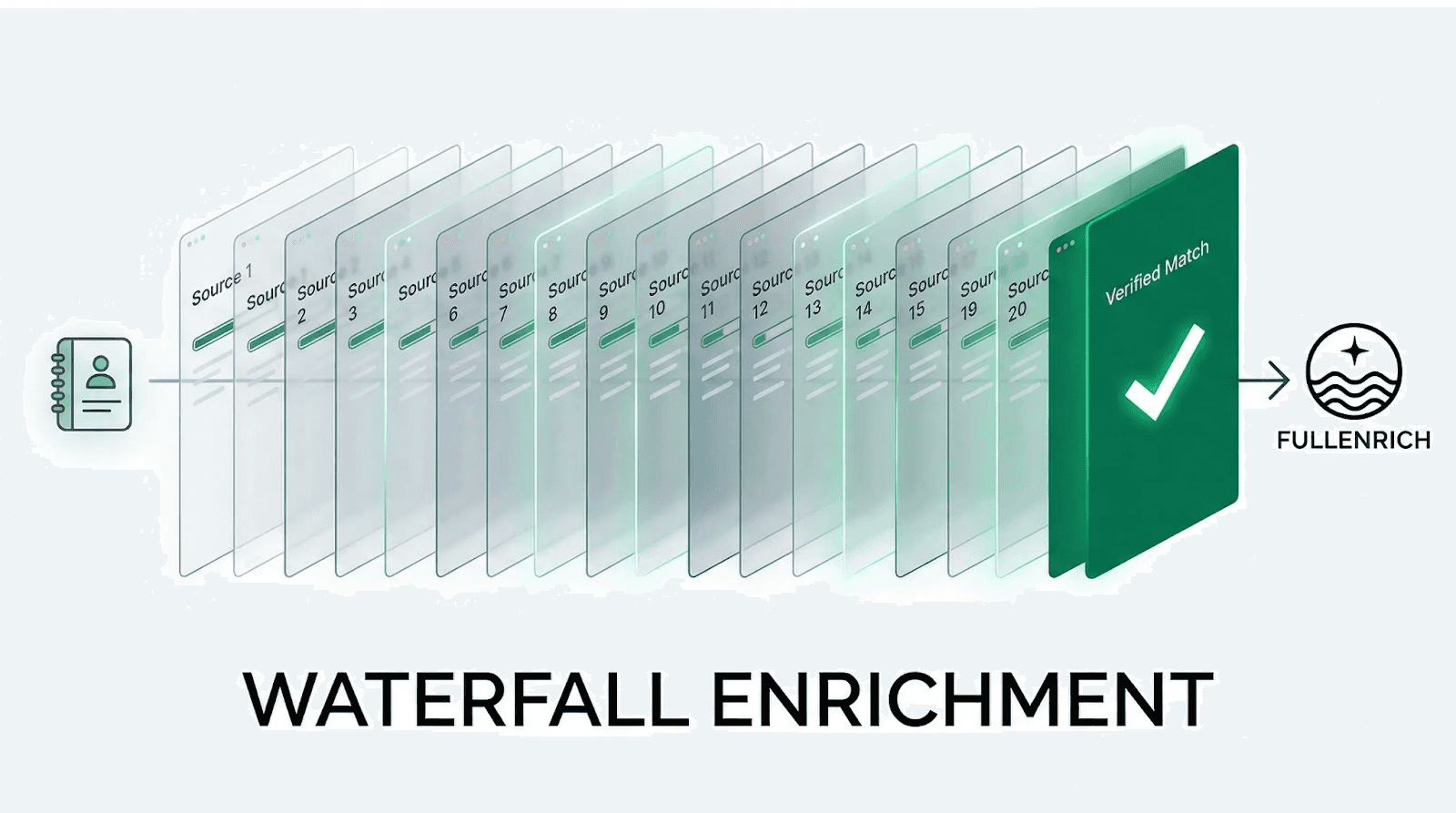
ABM teams operate across multiple geographies, company sizes, and industries. No single data provider covers all of them at acceptable match rates. This is the specific problem that waterfall enrichment solves.
FullEnrich aggregates 20+ data providers and queries them sequentially: the first provider returns what it has, unmatched accounts automatically move to the second, and so on until each record is either enriched or exhausted across all sources. Single-source tools typically achieve 40 to 60% match rates.
FullEnrich's waterfall approach delivers an 80%+ find rate across email and phone, with regional performance tuned to where coverage is strongest: 89% for US and Canada email, 84% for EMEA, 78% for LATAM and APAC.
For ABM programs specifically, two aspects of the waterfall model matter more than the headline match rate. The first is geographic optimization. European accounts route to providers with the strongest EMEA coverage before the sequence continues.
North American accounts prioritize US-specific databases. This routing logic prevents the coverage gaps that emerge when a single provider's weak region drags down overall match rates on a globally distributed account list.
The second is the credit model. FullEnrich only charges when enrichment succeeds and passes triple verification: SMTP email validation, carrier phone connectivity, and job title accuracy checks.
Failed lookups consume no credits. For ABM programs where a large portion of the target list may fall outside any single provider's coverage, this model eliminates the wasted spend that comes with flat-fee or per-attempt pricing.
Unlimited seats mean every member of the ABM team works from the same enriched data without licensing constraints. Annual credits roll over, removing the pressure to over-enrich accounts before a reset date.
Conclusion
ABM enrichment is not a data hygiene task. It is the operational foundation that determines whether account-based programs can execute at all. Without accurate firmographics, account selection is guesswork. Without technographics, positioning is generic.
Without buying committee contacts, campaigns reach one person in a 13-person decision-making group. Without intent signals, budget distributes equally across accounts ready to buy now and accounts that will not move for a year.
The enrichment quality ceiling is set by match rate. Single-source tools cap out at 40 to 60% coverage. Waterfall enrichment across 20+ providers pushes that past 80%, with geographic routing, triple verification, and pay-on-success pricing that eliminates the cost of failed lookups.
Frequently Asked Questions
What is ABM data enrichment?
ABM data enrichment is the process of appending firmographic, technographic, buying committee contact, and intent signal data to target account records. It converts basic account lists into complete organizational profiles with the intelligence needed to execute account-based programs: who to contact, what they use, and when they are ready to buy.
How is ABM enrichment different from lead enrichment?
Lead enrichment fills missing fields on individual contact records, typically email address, job title, and phone number. ABM enrichment operates at the account level: it maps organizational structure, identifies all buying committee members, reveals technology stack, and surfaces intent signals. The scope and output are fundamentally different.
How often should ABM account data be refreshed?
Active target accounts should be re-enriched every 60 to 90 days. High-priority accounts showing engagement signals warrant more frequent updates. B2B contact data decays at 22.5% annually, with job titles changing at nearly 66% per year, so data that was accurate at campaign launch becomes materially unreliable within a single quarter without continuous refresh.
What is intent data in ABM?
Intent data captures behavioral signals indicating buying readiness. First-party intent comes from your own channels: website visits, content consumption, pricing page activity. Third-party intent surfaces accounts researching your category across external publisher networks, review sites, and competitor properties. Combined, intent data separates in-market accounts from those that fit your ICP but are not currently evaluating.
What is the difference between one-to-one, one-to-few, and one-to-many ABM? One-to-one ABM targets a small number of strategic accounts with fully customized campaigns and dedicated resources. One-to-few applies cluster-level personalization to groups of accounts sharing similar characteristics. One-to-many scales ABM motions across large account sets using automation and dynamic content. Enrichment is essential at all three tiers, but the depth of account intelligence required increases significantly as you move toward one-to-one.
What are the 3 R's of ABM?
The three R's are Reputation, Relationships, and Revenue. Reputation means building awareness with target accounts before they are actively evaluating. Relationships means developing multi-threaded connections across buying committees rather than depending on a single champion. Revenue means converting those relationships into closed deals and expanding wallet share over time. Enrichment enables all three by supplying the buying committee intelligence, intent timing, and account context that each stage requires.



Other Articles
Cost Per Opportunity (CPO): A Comprehensive Guide for Businesses
Discover how Cost Per Opportunity (CPO) acts as a key performance indicator in business strategy, offering insights into marketing and sales effectiveness.
Cost Per Sale Uncovered: Efficiency, Calculation, and Optimization in Digital Advertising
Explore Cost Per Sale (CPS) in digital advertising, its calculation and optimization for efficient ad strategies and increased profitability.
Customer Segmentation: Essential Guide for Effective Business Strategies
Discover how Customer Segmentation can drive your business strategy. Learn key concepts, benefits, and practical application tips.