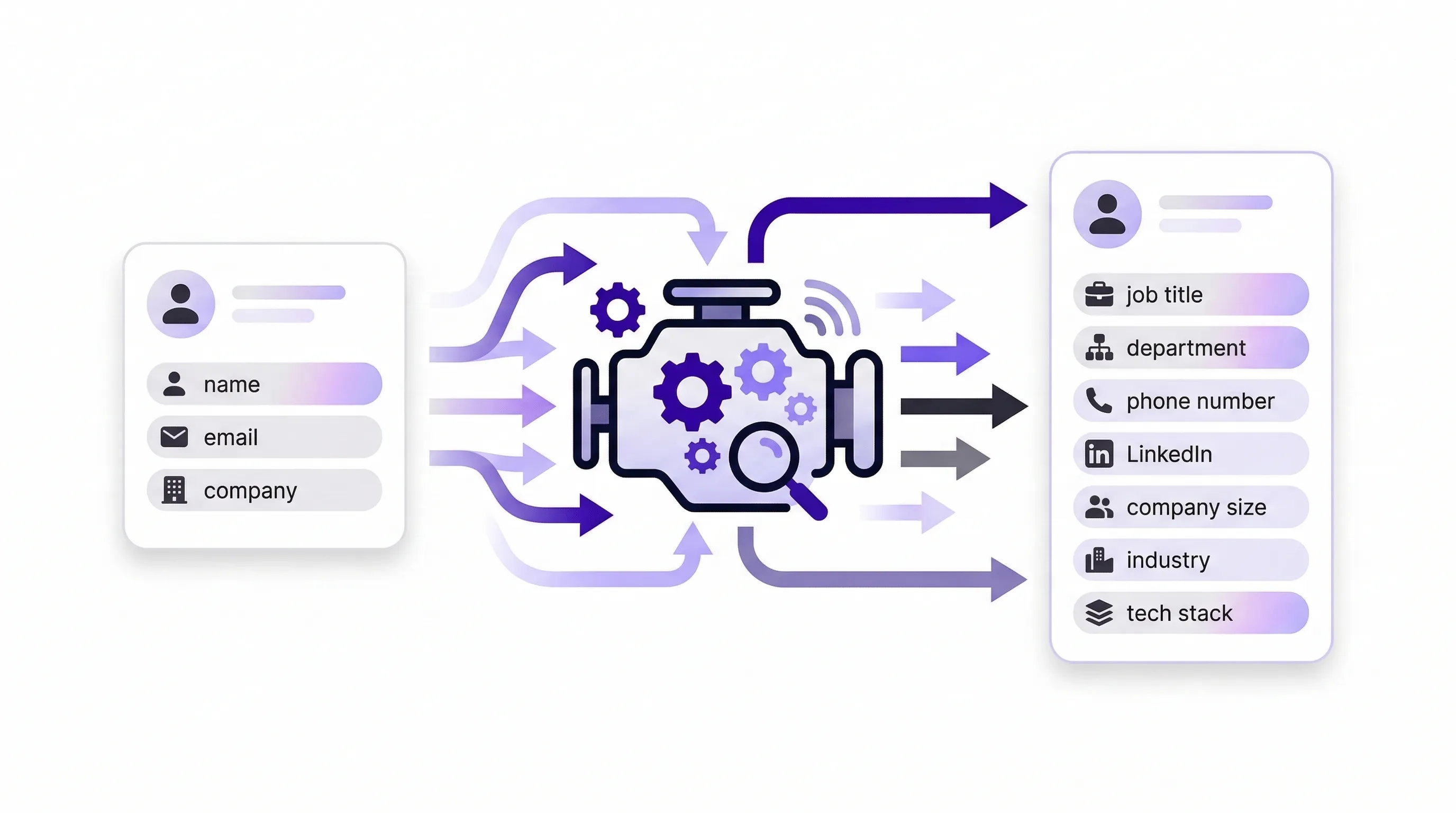

B2B data enrichment is the process of appending verified attributes from external sources to existing business records, turning incomplete CRM entries into actionable contact intelligence.
It adds job titles, seniority levels, firmographic data, technographic signals, verified emails, direct phone numbers, intent signals, and behavioral data to records that would otherwise sit as names and email addresses.
This guide covers what B2B data enrichment is, how it works, who benefits, how to evaluate platforms, and the compliance considerations every B2B team needs to understand.
What Is B2B Data Enrichment?
B2B data enrichment adds missing attributes to existing business records using external data sources. When a CRM contains only a contact's name, email, and company, enrichment automatically appends job title, seniority level, department, phone numbers, company size, revenue range, industry classification, technology stack, and buying intent signals.
In 2026, B2B buyers complete approximately 70% of their purchase journey before contacting a vendor, which means the window for a relevant first interaction is narrow.
Four related data operations are often confused with enrichment. Understanding the distinction clarifies what enrichment actually does.
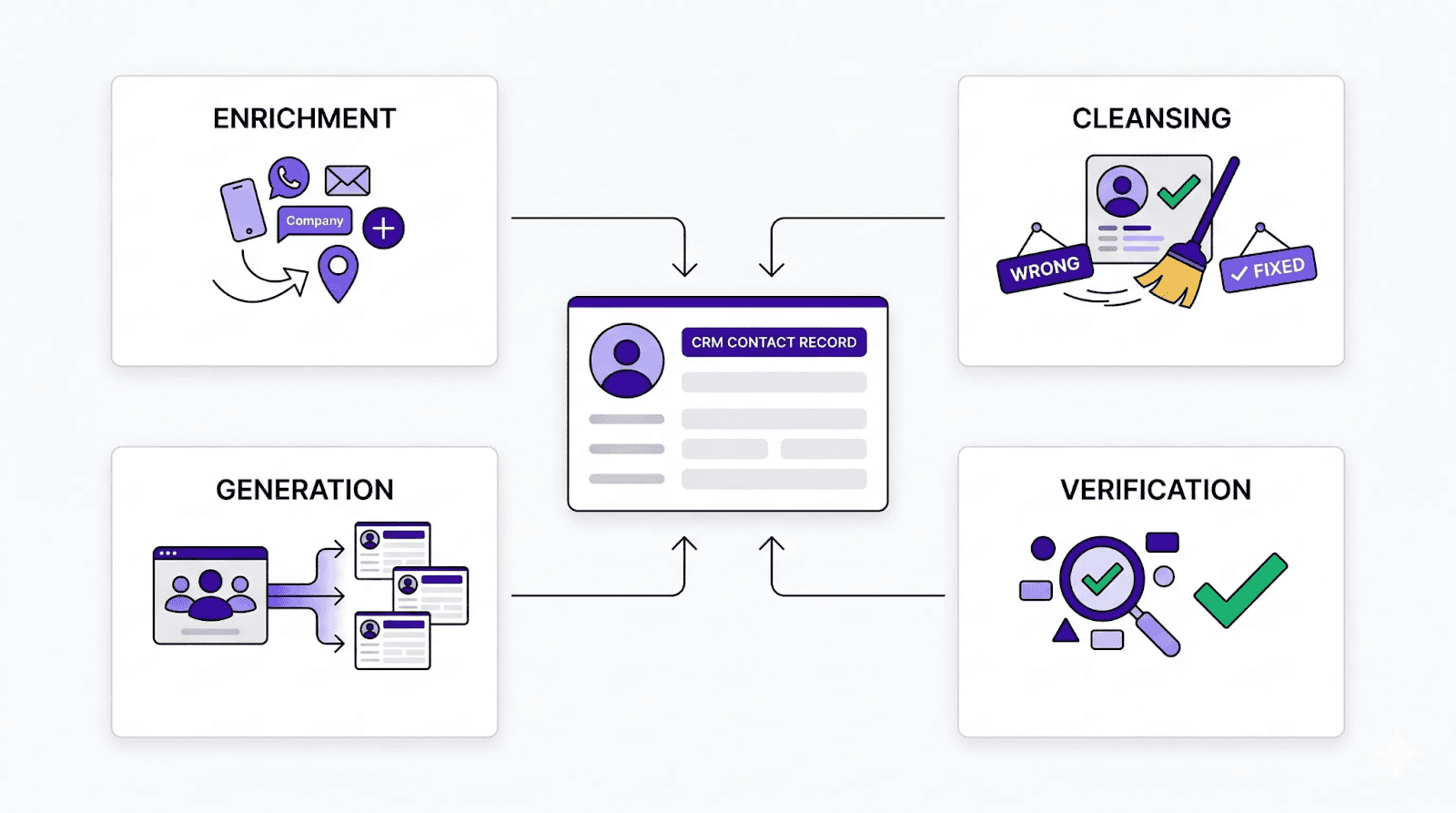
a) Data enrichment adds new attributes to existing records. You have a contact's email; enrichment adds their job title, direct phone number, and company firmographics.
b) Data cleansing fixes errors in existing attributes. You have incorrect job titles or outdated company names; cleansing corrects them.
c) Lead generation creates new records from scratch. You have no contacts at target accounts; generation finds them.
d) Data verification confirms the accuracy of existing attributes. You have phone numbers; verification tests whether they connect.
Most B2B enrichment platforms combine several of these capabilities, but enrichment specifically focuses on supplementing incomplete records rather than creating new ones or correcting existing data.
The Scope of B2B Data Enrichment
B2B data enrichment covers four primary categories, each serving distinct business functions across GTM teams. Together they form a complete intelligence layer that connects raw contact data to every stage of sales and marketing execution.
Contact data enrichment appends individual professional information to contact records. Starting from a name and email address, platforms add job titles, seniority levels, departments, direct dial phone numbers, mobile numbers, LinkedIn profile URLs, and professional backgrounds. This enables personalized outreach and accurate lead routing from the moment a record enters the CRM.
Company data enrichment enhances account records with organizational attributes. Employee counts, annual revenue ranges, industry classifications, headquarters location, founding date, ownership structure, funding rounds, and parent-subsidiary relationships all fall into this category. Marketing teams use firmographic data for segmentation; sales teams use it for qualification and deal sizing.
Technology stack enrichment reveals which software, platforms, and tools target companies currently use. Enrichment platforms identify CRM systems, marketing automation platforms, cloud infrastructure, analytics tools, communication systems, and industry-specific applications. This intelligence shapes competitive positioning and integration messaging.
Behavioral and intent enrichment appends signals indicating buying readiness. Website visits, content downloads, search behavior, competitor research activity, hiring patterns, funding events, and technology adoption signals all surface accounts that are actively shopping for solutions, enabling outreach timed to buying intent rather than arbitrary cadence.
Types of B2B Data Enrichment
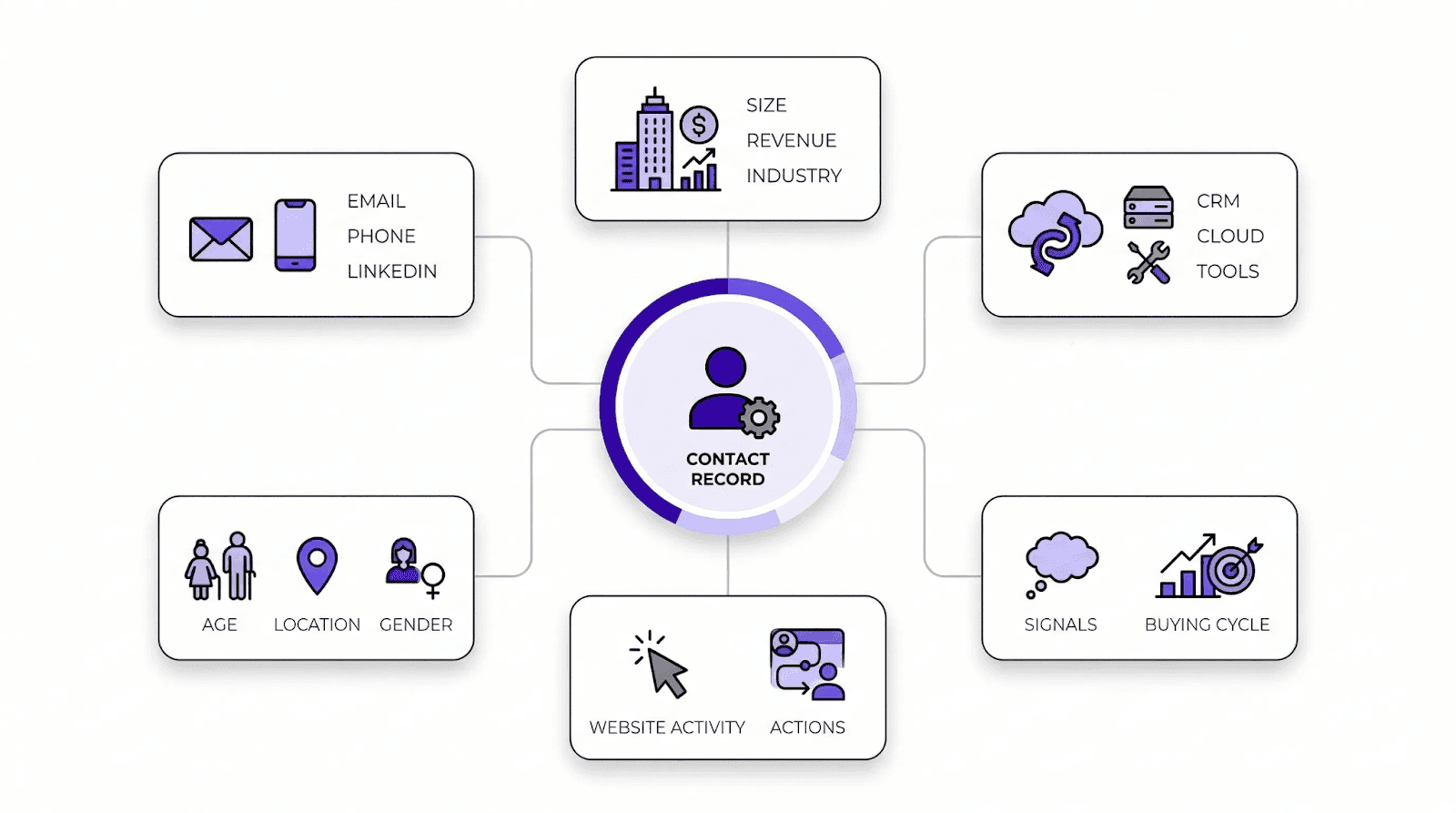
The table below maps each enrichment data type to what it contains and its primary GTM use cases.
Data Type | What It Includes | Primary Use Cases |
Contact Data | Verified emails, direct dials, mobile numbers, LinkedIn URLs | Outreach enablement, contact discovery, routing accuracy |
Firmographic Data | Company size, revenue, industry, location, structure, funding stage | ICP matching, segmentation, account prioritization |
Demographic Data | Job title, seniority, department, function, reporting structure, tenure | Decision-maker identification, buying authority assessment |
Technographic Data | Current software stack, cloud platforms, marketing tools, sales systems | Competitive displacement, integration plays, use case targeting |
Intent Data | Research behavior, content engagement, competitor visits, buying signals | Timing optimization, hot account identification, prioritization |
Behavioral Data | Website visits, email engagement, content downloads, event attendance | Lead scoring inputs, engagement tracking, nurture sequencing |
Financial Data | Revenue, funding rounds, valuation, growth rate | Deal sizing, payment capability assessment, expansion potential |
Geographic Data | Office locations, regional presence, market coverage, timezone | Territory routing, localization, timing optimization |
How Each Data Type Powers GTM Execution?
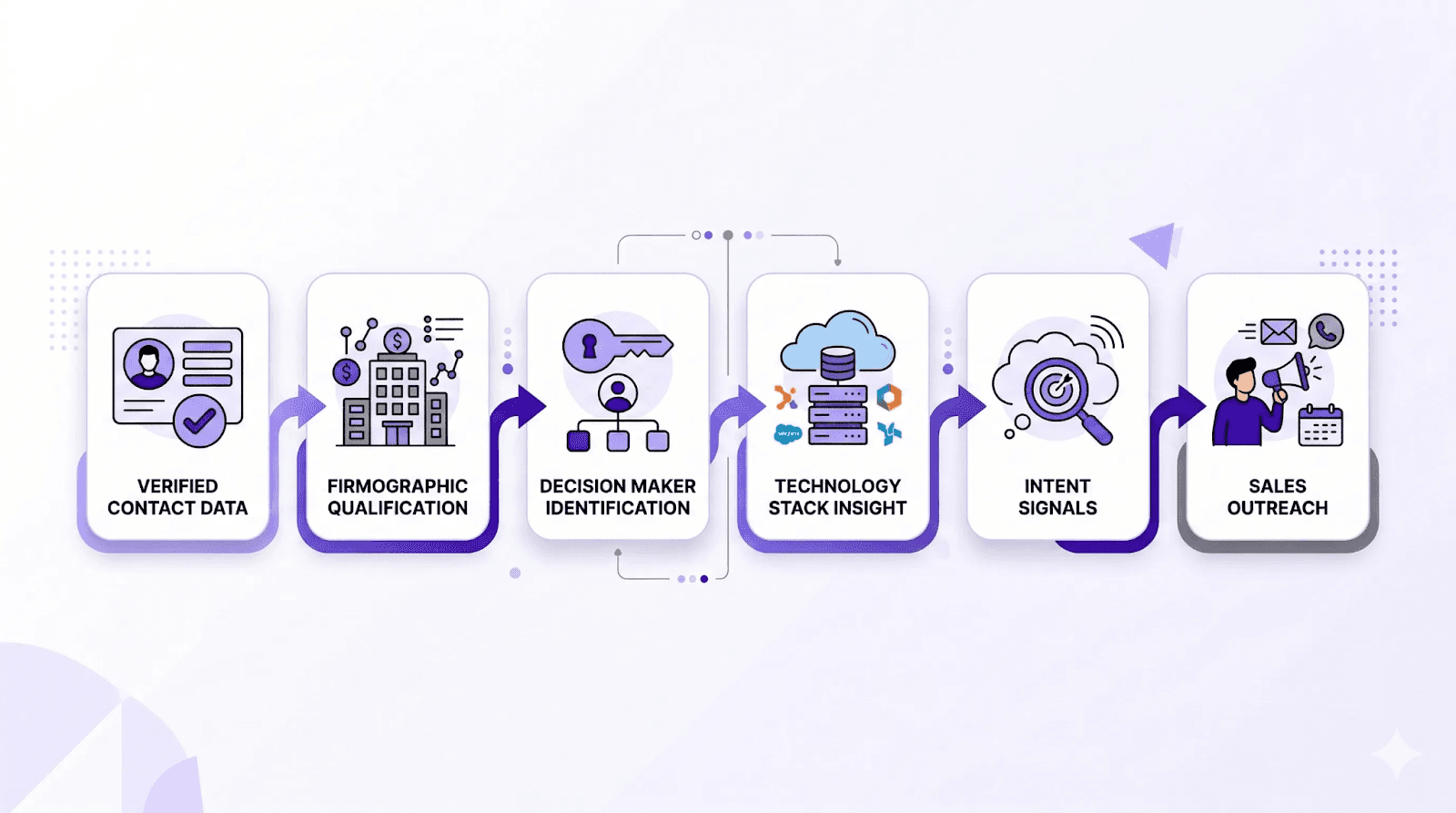
Each enrichment data type serves a specific function in the GTM workflow. Understanding how they connect to execution decisions helps teams prioritize which types to enrich first and how to configure downstream workflows around the results.
Contact data forms the foundation because without verified emails and working phone numbers, every other enrichment attribute is academic. Modern enrichment platforms verify deliverability before appending contacts, preventing bounce rates that damage sender reputation and ensuring sales teams can actually execute the outreach they plan.
From there, firmographic data determines which accounts qualify. Instead of manually checking whether each lead fits the ideal customer profile, enriched company size and revenue data automatically qualifies or disqualifies accounts the moment they enter the system.
Demographic data then identifies who within those accounts holds buying authority. A contact with a Manager title requires different messaging than a VP or C-suite executive who controls budget. Department information reveals whether contacts evaluate the solution from a technical, financial, or operational lens, which changes the angle of every outreach message.
With the right contact confirmed, technographic data shapes the conversation before the first call. If a prospect uses a competitor's platform, the conversation is about displacement. If they use complementary tools, the conversation is about integration value. If they are on legacy systems, the conversation is about modernization.
Intent data then addresses the timing question. Not every ICP-fit prospect is ready to buy today. Intent signals separate accounts actively researching solutions from those requiring long nurture cycles, so high-intent prospects get immediate sales attention while low-intent contacts stay in marketing programs until signals change.
Behavioral data feeds the scoring and automation layer. Website visits, content downloads, and email clicks indicate engagement level and buying stage, enabling automated workflows that respond to engagement patterns with relevant content and timely outreach.
Finally, financial and geographic data support deal execution. Financial signals help sales teams size deals appropriately and identify accounts with active purchasing capacity. Geographic data optimizes routing and timing, ensuring contacts reach reps familiar with their regional context and that outreach arrives during business hours.
Why B2B Data Enrichment Matters?
Three converging pressures make enrichment non-negotiable for competitive B2B teams in 2026.
The shrinking sales window: B2B buyers complete approximately 70% of their purchase journey before engaging a sales rep. By the time a prospect makes contact, they have already researched solutions, compared competitors, and formed preferences. Sales teams that require 2 to 3 days of manual research before first contact have already lost ground. Enrichment delivers instant, verified intelligence at the moment of contact so reps engage with relevance rather than guesswork.
The personalization revenue gap: McKinsey research shows that companies excelling at personalization generate 40% more revenue than average players. Personalization requires data. Generic outreach fails in crowded inboxes. Outreach that references a prospect's technology stack, recent funding event, or organizational change converts at materially higher rates than template sequences. Enrichment is what makes personalization scalable rather than limited to the few accounts a rep can manually research.
The AI data quality multiplier: AI and automation amplify data quality problems in both directions. Lead scoring models, predictive analytics, and automated routing workflows depend entirely on input data accuracy. Feed incomplete records into a scoring model and it prioritizes the wrong prospects. Feed garbage data into routing automation and leads reach the wrong reps. Enrichment is the data foundation that makes AI-driven GTM execution reliable rather than unpredictable.
How B2B Data Enrichment Works?
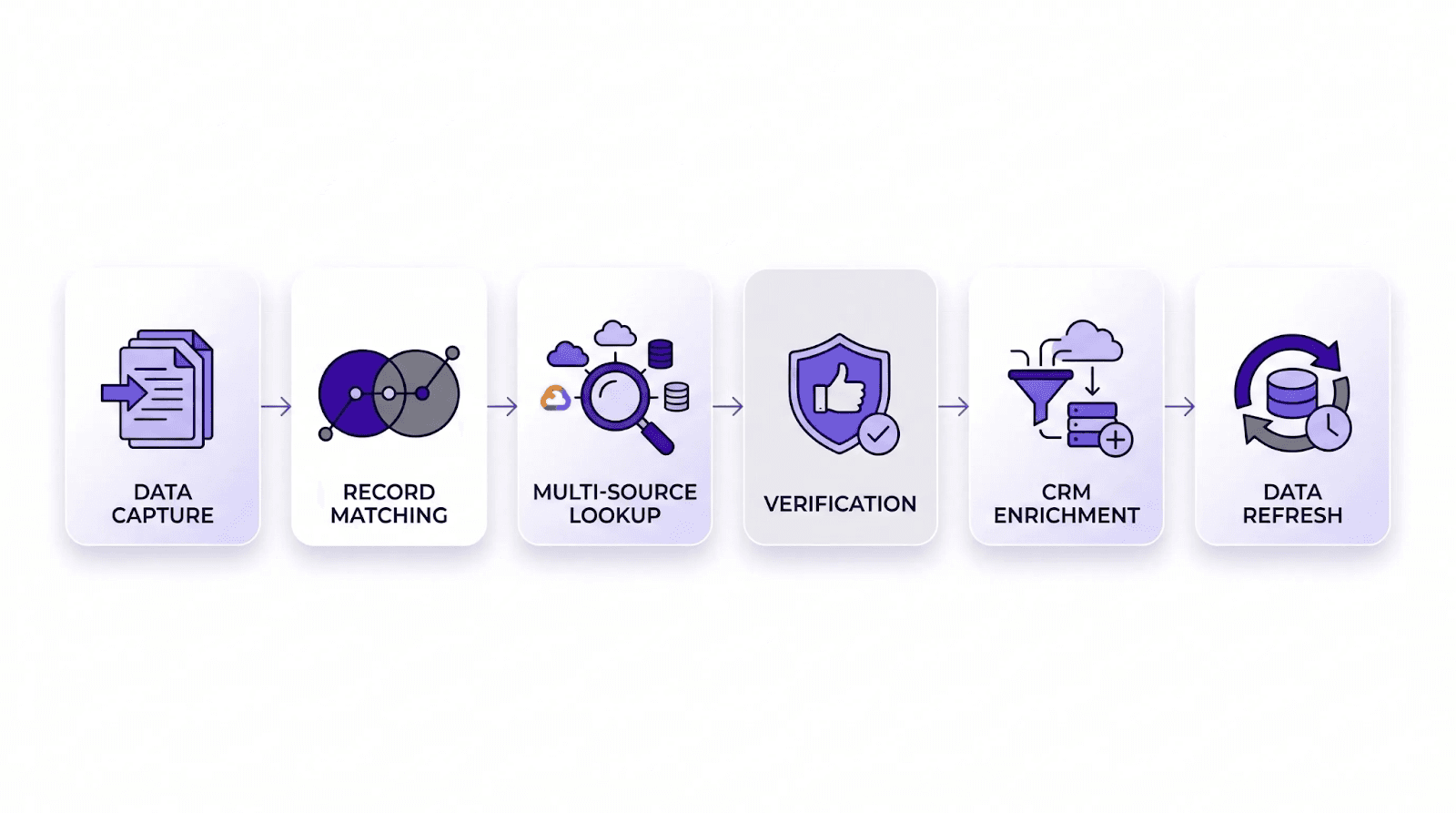
Understanding the enrichment process helps teams implement it correctly and diagnose problems when results fall short. The process runs through six steps from initial data capture to continuous maintenance.
Step 1: Data Entry and Capture
Enrichment begins when contact data enters the system through inbound form submissions, event registrations, manual CRM entry, or sales prospecting activity. At this stage, records typically contain just enough to identify an individual but lack the intelligence needed for qualification, personalization, or routing. This gap triggers the enrichment process.
Step 2: Record Matching and Identification
The enrichment platform matches the incomplete record against its data sources using available identifiers. Email-based matching extracts the company domain and matches it to firmographic records while also checking whether the specific contact exists in the database.
Name plus company matching searches for the exact individual within the organization. LinkedIn URL matching provides the highest accuracy because the URL serves as a unique identifier. Domain matching enriches company-level attributes even when no specific contact identifier is available.
Match confidence determines what gets returned. A record matched by email or LinkedIn URL returns a comprehensive enriched profile. A record matched by name and company alone returns only fields that can be verified with sufficient confidence. A name with no company context produces no result rather than a speculative one.
Step 3: Multi-Source Data Aggregation
Single-source enrichment queries one database and stops. If that provider lacks the contact, the query fails even though other sources might have complete information. Waterfall enrichment solves this by querying multiple data providers sequentially until a verified match is found.
One provider returns an email but no phone. The next returns a mobile number. The next confirms job title through cross-referencing. This continues through the provider stack until comprehensive enrichment is achieved or all sources are exhausted.
Geographic optimization improves match rates further. Intelligent platforms route European contacts to providers with stronger EU coverage, North American contacts to US-focused databases, and APAC contacts to providers with regional strength. This regional routing maximizes match rates rather than treating all providers as interchangeable.
Step 4: Data Verification and Quality Control
Finding data is half the work. Verification determines whether what was found is accurate and usable. Email verification checks deliverability through syntax validation, domain verification, mailbox existence checks, catch-all detection, and spam trap identification.
Only emails passing all verification layers get appended. Phone verification confirms active carrier assignment, detects line types distinguishing mobile from landline, and flags disconnected numbers.
Job title verification cross-references multiple sources before returning a result. Failed verification means the data point is not returned and no credit is consumed on platforms with success-only billing.
Step 5: CRM Integration and Data Appending
After enrichment and verification complete, the platform writes appended data to the CRM through direct integrations or API connections. Smart field mapping directs enriched attributes to the correct fields without overwriting accurate manually entered data.
Real-time enrichment runs the moment a new contact enters the system. Batch enrichment handles existing records in bulk, used for database cleanups and backfill projects.
Step 6: Continuous Refresh and Maintenance
B2B contact data deteriorates at approximately 2% per month, meaning nearly 25% of a database becomes outdated annually without active maintenance. Scheduled refresh cycles re-check contacts against current data sources on a regular cadence, updating changed information and flagging stale records.
Job change alerts notify teams when contacts switch companies, creating both a risk to manage and an expansion opportunity to pursue. Company change tracking monitors funding events, acquisitions, and hiring surges that signal optimal timing for outreach.
Benefits of B2B Data Enrichment
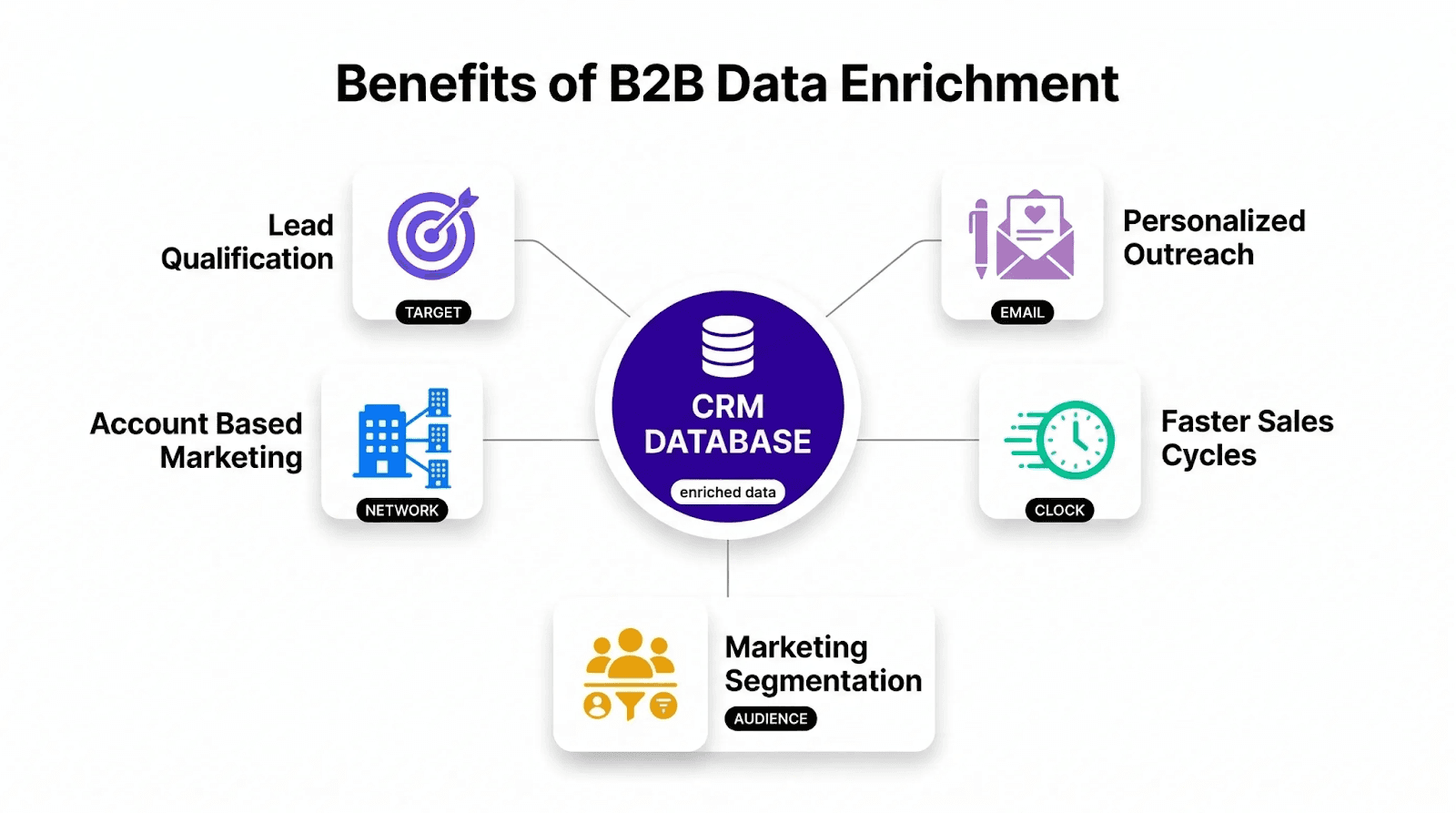
Along with other numerous benefits, B2B data enrichment can improve lead qualification and scoring, conversation rates, and sales cycles.
Improved Lead Qualification and Scoring
Scoring models are only as reliable as the data feeding them. Enriched firmographic and demographic attributes, including company size, job title, industry, seniority, and technology stack, give models the inputs they need to qualify leads accurately. Without enrichment, models operate on partial data and push the wrong prospects to the top of the queue.
Higher Conversion Rates Through Personalization
McKinsey research confirms that companies excelling at personalization generate 40% more revenue than average players. Enriched profiles make that personalization possible at scale. Outreach that references a prospect's technology stack, recent funding event, or company stage earns responses that generic sequences do not.
Faster Sales Cycles
Sales reps spend up to 40% of their time searching for contact information instead of actively selling. Enrichment eliminates that research overhead entirely. Reps open a record and find verified contact details, current job title, and company context already populated. Deals move faster when qualification happens on data rather than back-and-forth discovery.
Enhanced Marketing Segmentation
Firmographic and intent data let marketing teams build micro-segments rather than broad lists. Enterprise accounts get different messaging than SMB targets. IT buyers receive different content than finance executives. Intent signals concentrate campaign spend on accounts actively evaluating solutions rather than spreading it evenly across segments regardless of readiness.
Improved Account-Based Marketing Execution
ABM fails without buying committee data. Enrichment identifies decision-makers at target accounts, maps reporting structures, and surfaces intent signals that indicate when an account is ready to engage. The difference between ABM that drives pipeline and ABM that burns budget is the quality of the data it runs on.
Better Sales and Marketing Alignment
Lead quality disputes between sales and marketing almost always trace back to inconsistent data. Shared enriched firmographic and demographic attributes give both teams a common view of what a qualified lead looks like. MQL-to-SQL handoffs happen on agreed criteria rather than subjective judgment.
How to Evaluate a B2B Data Enrichment Platform
Selecting the right enrichment platform requires matching capabilities to your specific workflow needs, geographic requirements, and budget. Seven criteria matter most.
Geographic coverage is the starting point. A vendor's headline match rate is only meaningful against your actual ICP. Request a coverage test on 100 to 200 of your real target accounts before committing. A platform delivering 85% match rates on US mid-market companies may return 40% on European SMBs.
Data freshness and validation determine whether enriched data is usable. On-demand fetching produces fresher results than static databases that update on a delay. For email validation, triple verification against live mail server records produces materially lower bounce rates than format checking alone.
Pricing transparency prevents cost surprises. Understand whether failed enrichment attempts consume credits, whether seat fees stack on top of credit costs, and whether overage penalties apply. Platforms that charge only on verified successful enrichment produce more predictable economics at volume.
Integration ecosystem determines implementation complexity. Native HubSpot and Salesforce integrations reduce engineering overhead. Zapier and Make compatibility covers custom workflows. Direct API access is essential for product-embedded enrichment or high-volume batch operations.
Waterfall versus single-source architecture directly impacts match rates. Single-source platforms stop when their database lacks a record. Waterfall platforms sequence multiple providers until a verified result is found, producing consistently higher coverage across niche industries, international markets, and role types that any single database covers poorly.
Data quality verification standards reveal what the platform actually does before appending data. Email deliverability verification against live mail servers, phone confirmation against carrier databases, and job title cross-referencing across multiple sources are the baseline for reliable enrichment output.
Compliance posture is non-negotiable for teams enriching EU-based contacts. Confirm SOC 2 Type II certification, GDPR documentation, and CCPA alignment. The key distinction is between platforms that maintain static databases of personal contact records and those that fetch data on demand, which reduces compliance exposure for both the platform and its customers.
How FullEnrich Approaches B2B Data Enrichment?
FullEnrich is a waterfall enrichment platform that aggregates 20+ premium data providers, including Apollo, Lusha, ZoomInfo, Hunter, Datagma, and ContactOut, and sequences queries through them until it finds and verifies a contact's email, phone, and firmographic data.
Rather than building or maintaining a static database, FullEnrich fetches data on demand, which keeps match rates high across diverse industries, company sizes, and geographies where single-source tools consistently produce gaps.
Find rates reflect this architecture directly. FullEnrich reaches an 89% email find rate for US contacts and 86% phone find rate, with EMEA at 84% email and 71% phone, LATAM at 78% email and 67% phone, and APAC at 78% email and 66% phone. Triple email verification keeps bounce rates below 1%, protecting sender reputation across all outbound sequences.
The credit model charges only on verified results. Failed lookups cost nothing. Unlimited user seats on all plans mean entire GTM teams share one credit pool without per-head licensing fees. Native integrations with HubSpot, Salesforce, Pipedrive, Google Sheets, Zapier, Make, and direct API access cover every major workflow configuration.
Best B2B Data Enrichment Practices
Most enrichment failures happen at the configuration and implementation stage, not the data stage. Poor field priorities, loose overwrite rules, absent quality monitoring, and poorly timed triggers all produce the same result: credits spent with no measurable improvement to pipeline or outreach quality. These practices address the decisions that determine whether enrichment delivers ROI.
Enrich in Real Time, Not Batch Only
Configure enrichment to trigger automatically when new contacts enter the CRM. Real-time enrichment ensures every inbound lead arrives complete before it touches a routing rule or scoring workflow. Batch-only enrichment creates gaps between when a lead is captured and when it has the data needed to be acted on. Both modes serve different purposes: real time for inbound, batch for existing database cleanup.
Set Data Quality Thresholds Before Accepting Results
Not all enriched data carries the same confidence level. Establish minimum confidence scores before accepting appended fields into live records. Require high deliverability standards for email enrichment and active line confirmation for phone numbers. Rejecting low-confidence matches keeps database integrity intact rather than accepting unreliable data that creates problems in downstream workflows.
Refresh Data Every 3 to 6 Months
Schedule automated refresh cycles so contact information, job titles, and firmographics stay current without manual intervention. High-priority accounts in active pipeline warrant quarterly refresh. Dormant contacts can refresh semi-annually or be deprioritized based on pipeline value.
Connect Enriched Fields to Downstream Workflows
Enrichment that populates fields no workflow reads produces no pipeline value. Every enriched field should drive at least one downstream action: a lead score attribute, a routing rule, a sequence personalization token, or a segmentation criterion. Map which enriched fields feed which actions before selecting what to enrich. This mapping exercise often reveals that fewer fields than expected are actually needed.
Protect Manually Entered Data
Configure field mapping to preserve manually verified information when it conflicts with enrichment results. If a rep confirmed a job title through a direct conversation, automated enrichment should not overwrite that verified data with a potentially outdated database record. Conservative field-level overwrite rules protect the accuracy that human verification produces.
Monitor Match Rates Against Your Actual ICP
Track enrichment success rates by geography, company size, and lead source against your actual target accounts, not vendor-reported averages. Identify coverage gaps that point to weak identifiers in the database or mismatched provider selection. Match rates that consistently fall below acceptable thresholds signal the need for additional data providers or a waterfall approach that fills gaps the primary source cannot cover.
B2B Data Enrichment and Compliance
GDPR, CCPA, and PECR, each impose distinct obligations on B2B teams that use enriched contact data for outreach. The approach an enrichment platform takes to data handling has direct implications for a customer's own compliance posture.
GDPR requires a lawful basis for processing personal data. For B2B outreach, legitimate interest is the most commonly cited basis but requires a documented balancing test. GDPR also grants the right to erasure: if a contact requests deletion, the organization must honor it, which is more complex when personal data sits in a static vendor database than when it is fetched on demand.
CCPA grants California residents the right to know what personal information is collected about them, to opt out of the sale of their data, and to request deletion. B2B contact data falls within CCPA scope when the contact is a California resident.
The critical architecture distinction is between platforms that maintain static databases of personal contact records and platforms that fetch data on demand. Static databases raise questions about consent at the point of collection, data residency, and the right to erasure.
On-demand fetching aligns with data minimization principles and reduces compliance surface area for both the platform and its customers. Confirming SOC 2 Type II certification, GDPR compliance documentation, and CCPA alignment before committing to any enrichment platform is a necessary step for any team that handles personal data at scale.
Conclusion
B2B data enrichment is the operational foundation that makes every GTM workflow more reliable. Lead scoring, CRM routing, personalized outreach, ABM targeting, and pipeline prioritization all depend on the quality of the data feeding them. Incomplete records produce unreliable outputs regardless of how sophisticated the workflows built on top of them are.
The teams that build durable pipeline in 2026 operate on complete, verified, continuously refreshed contact and company intelligence. Waterfall enrichment, built on a stack of multiple providers queried in sequence, is the architecture that produces the highest match rates across diverse geographies, industries, and company sizes.
Pair that with real-time enrichment triggers, sound field-level overwrite rules, and scheduled refresh cycles, and the result is a CRM that stays accurate without manual intervention and a GTM motion that executes on data rather than guesswork.
See how FullEnrich helps B2B teams enrich data at scale
FAQs
What is the difference between B2B data enrichment and lead generation? Lead generation creates new contact records from scratch using search criteria. B2B data enrichment enhances records you already have by appending missing attributes. The two serve different functions and are frequently used together: generation finds new prospects, enrichment makes those prospects actionable.
What inputs does B2B data enrichment require?
Most platforms accept a name plus company domain, a LinkedIn profile URL, a CSV file upload, or a direct API call. Advanced platforms also support reverse email lookup, which takes an email address as input and returns the full enriched profile including job title, company data, and contact details.
How does waterfall enrichment differ from single-source enrichment?
Single-source enrichment queries one database. If that provider lacks the record, the query fails. Waterfall enrichment sequences queries across multiple providers in order, moving to the next when the previous returns no result. Because different providers have different coverage strengths by geography, industry, and role type, stacking them produces materially higher match rates than any single provider can achieve alone.
How often should a B2B database be re-enriched?
Active contacts in current sequences benefit from re-enrichment triggered by job change alerts or pipeline stage transitions. Broader database refreshes on a quarterly cadence balance data freshness against credit consumption. Dormant contacts can be refreshed semi-annually or deprioritized based on their pipeline value.
Does B2B data enrichment work for international markets?
Yes, but platform selection matters significantly. Single-source platforms built around US databases frequently produce weak coverage in EMEA, APAC, and LATAM. Platforms that aggregate multiple providers, including those with regional coverage strength, produce substantially higher match rates for international enrichment.
What should teams do when enrichment returns low match rates?
Low match rates typically point to weak identifiers in the database rather than platform failure. Business email addresses and LinkedIn URLs produce the highest match confidence. Name-only records with no company context produce the lowest. Improving form capture to collect business email domains and LinkedIn URLs at the point of submission is the most effective way to raise match rates systematically.
How does B2B data enrichment support ABM programs?
ABM requires knowing who sits on the buying committee at target accounts, what their roles and seniority levels are, and which accounts are showing active buying intent. Enrichment delivers all three: firmographic and demographic data maps the buying committee, technographic data informs positioning, and intent data surfaces which target accounts are actively researching solutions right now.



Other Articles
Cost Per Opportunity (CPO): A Comprehensive Guide for Businesses
Discover how Cost Per Opportunity (CPO) acts as a key performance indicator in business strategy, offering insights into marketing and sales effectiveness.
Cost Per Sale Uncovered: Efficiency, Calculation, and Optimization in Digital Advertising
Explore Cost Per Sale (CPS) in digital advertising, its calculation and optimization for efficient ad strategies and increased profitability.
Customer Segmentation: Essential Guide for Effective Business Strategies
Discover how Customer Segmentation can drive your business strategy. Learn key concepts, benefits, and practical application tips.