

n B2B outreach, it's easy to chase job titles and phone numbers, but we often miss the bigger picture of their company. A contact record shows who someone is, whereas company enrichment reveals where they sit and why their business is shifting direction.
Take a simple domain like "acme.com": enrichment layers on revenue trends, tech stack changes, even new office openings. The data enrichment market powering these insights will hit $5.39B by 2033 as teams demand this context. Spot their recent AWS switch? Your pitch goes from generic to "We fix your exact migration pain."
Company Enrichment vs Contact Enrichment
While these two terms are often grouped, they serve very different roles in your strategy. Contact data gets you the name; company data shows their full setup. Contact enrichment is the compass; it points you toward the specific person (the "Who") you need to speak with.
Company enrichment is the map; it shows you the entire landscape of the account (the "Where" and the "What").
Contact Enrichment is personal. It’s about finding a LinkedIn URL, a verified email, or a work history. In simple terms, its goal is to help you reach a human being.
Company Enrichment is structural. It focuses on the business as a whole. Instead of looking for an individual, it looks for firmographic details like annual revenue, headcount growth, and office locations. It also looks for technographics, the specific tools and software the company uses to run its operations. Without company context, your contact data is just a list of names.
How Does Company Enrichment Work?
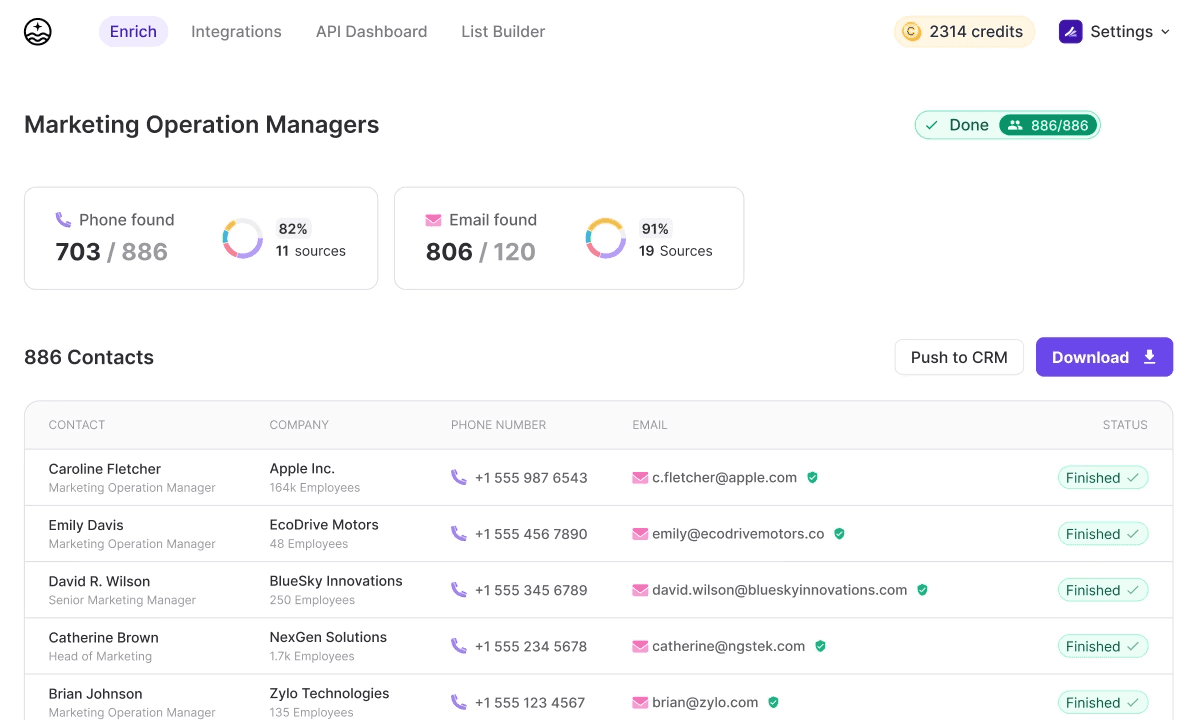
The process of company enrichment is like investigative journalism for data. It starts with a simple identifier, usually a company name or a website URL. Because a domain is a unique digital fingerprint, it is the most reliable way to make sure the system is looking at the correct business.
Once the system has that domain, it begins aggregating information from thousands of disparate sources. This includes public business registries, financial filings, press releases, and even job boards. Top-tier tools use a waterfall query to verify this data; they check multiple premium databases sequentially to ensure the headcount or revenue numbers are the most recent available.
Finally, all these scattered data points are synthesized into a single account profile and pushed into your system, giving you a complete "360-degree view" of the business in seconds.
What are the Benefits of Company Enrichment?
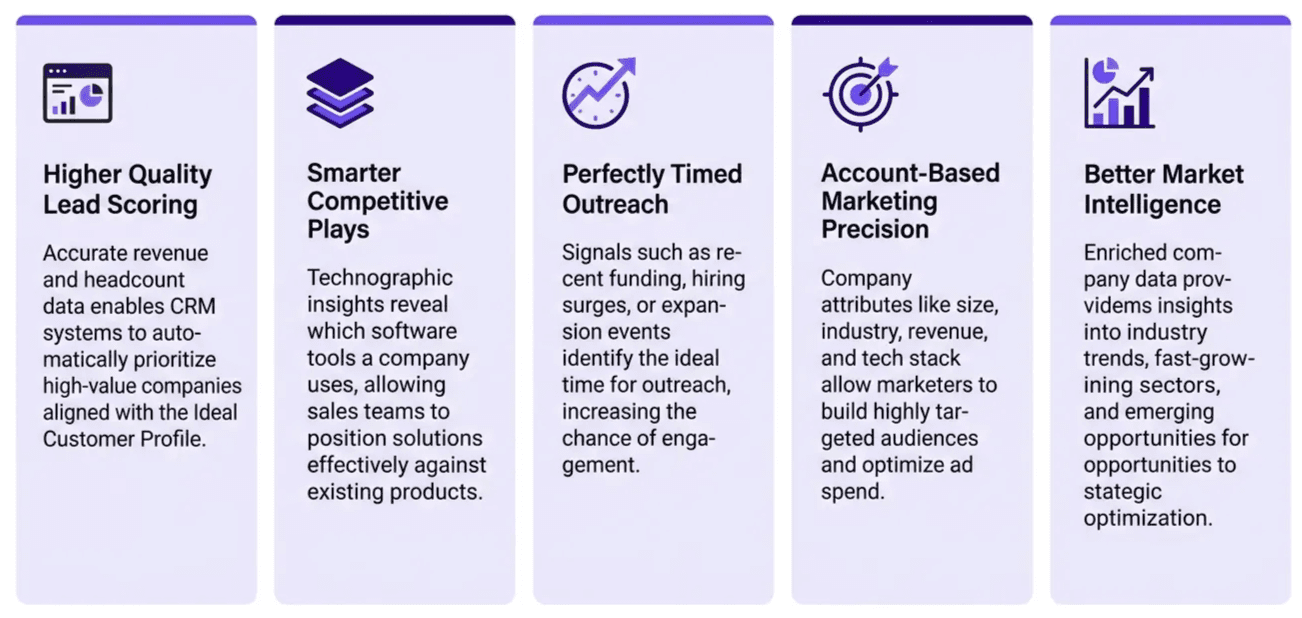
Understanding the business behind the contact is the fastest way to stop wasting time on the wrong accounts. When you enrich a company profile, you are essentially giving your sales and marketing teams a "cheat sheet" for that business. Here are the core benefits:
Higher Quality Lead Scoring: You can stop guessing which accounts are "big enough." With accurate revenue and headcount data, your CRM can automatically prioritize high-value companies that fit your Ideal Customer Profile.
Smarter Competitive Plays: Knowing exactly what software a company uses (technographics) allows you to customize your pitch. You can speak directly to why your solution is better than what they currently have. See how HG Insights detects tech stacks
Perfectly Timed Outreach: By tracking company signals like recent funding or new office openings, you can reach out when a company is in a "buying window." Timing is often the difference between a "no" and a "let’s talk."
Account-Based Marketing (ABM) Precision: You can build highly targeted ad audiences based on specific company attributes, making sure your marketing budget is only spent on the exact types of businesses you want to win.
Better Market Intelligence: Company enrichment helps you see the "big picture" of your industry. You can spot trends like which sectors are growing the fastest and shift your strategy to follow the money.
The 4 Pillars of Company Data
To truly understand a business entity, you need to look at it from four different angles. Each of these pillars provides a unique piece of the puzzle to help you determine whether a company is a good fit for your product.
Structural Firmographics: These are the vitals of a company. It includes the basics such as industry classification, annual revenue, total employee count, and the locations of their headquarters and satellite offices. This tells you if the company has the scale to work with you.
Digital Technographics: This is the "hidden" layer. Data Enrichment tools can detect the software and hardware a company uses, from its CRM and email provider to their website’s security protocols. Just imagine, if you know your prospect had just installed a competitor's tool, your pitch would definitely change from "Introduction" to "Comparison."
Strategic Signals: This pillar tracks the company’s movement. Is there a recent merger? Did they just secure a Series C funding round? Are they hiring aggressively in their engineering department? These signals act as "triggers" that indicate a company is changing and likely needs new solutions.
Corporate Hierarchy: Many businesses aren't standalone entities; they are part of a larger family. This pillar maps out parent companies and subsidiaries. Understanding this hierarchy prevents you from pitching a subsidiary when the decision-making power actually lies with the parent company.
How To Use Company Data For Growth?
Having a deep profile of a company is only valuable if you know how to turn that information into a sales opportunity. Company enrichment powers ICP scoring that drives GTM success. Instead of guessing which accounts to target, they use firmographic data such as revenue growth and headcount surges to rank companies by their likelihood of buying.
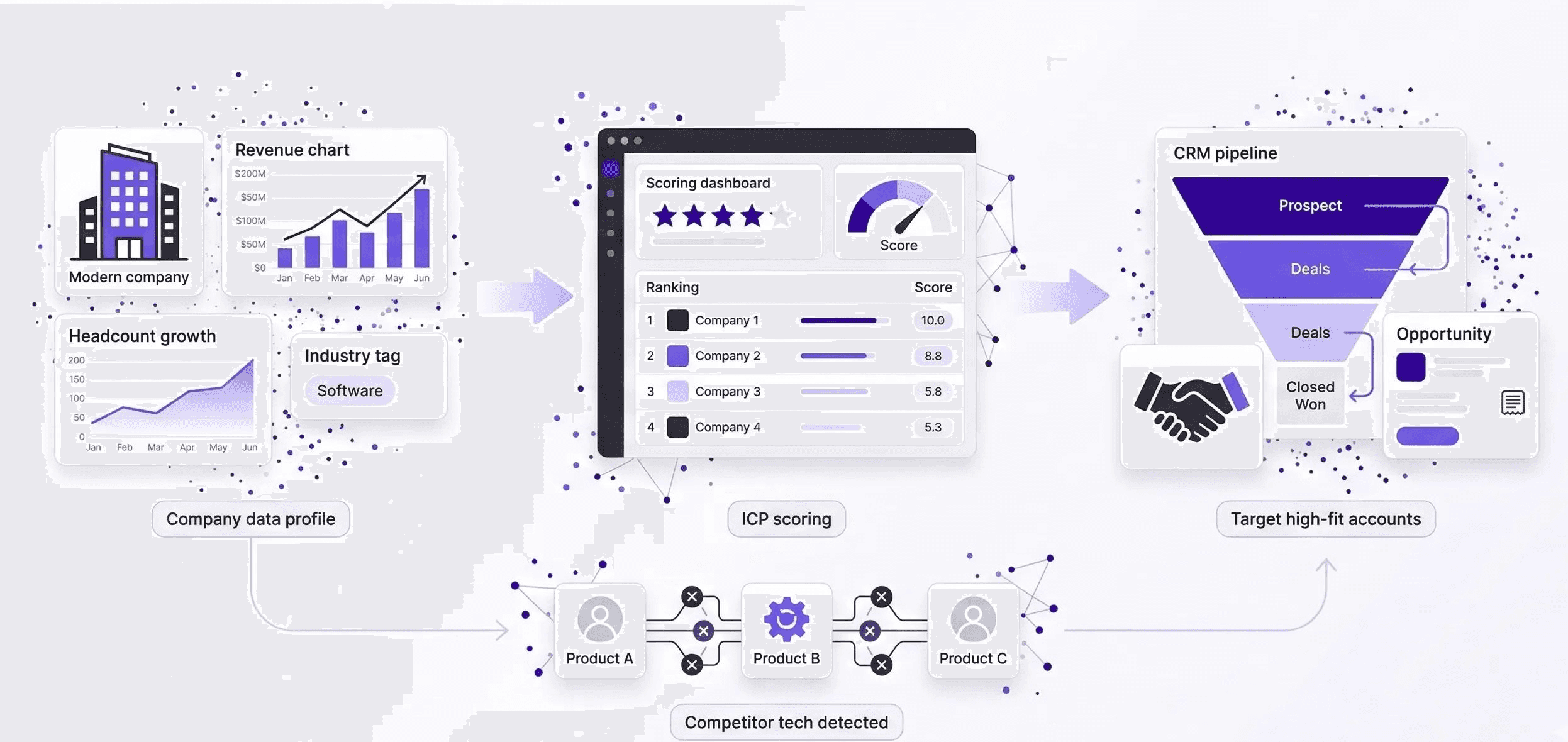
Another major growth lever is Competitive Displacement. By using technographic enrichment, you can see exactly which companies are using your competitors' software.
Even better, you can track "technographic signals" to see when they were installed. If you know a company signed a contract with a competitor two years ago, you can predict their renewal window and reach out at the exact moment they are considering a change.
Best Practices: Avoiding the "Static Data" Trap
The biggest mistake you can make with company enrichment is treating it as a one-time event. Business data moves fast; a company that was a "perfect fit" six months ago might have been acquired or changed its entire strategy today.
To keep your data actionable, you must move toward Real-Time Enrichment. Relying on static lists from last year is a recipe for missed opportunities and embarrassing mistakes in your outreach.
You should also focus only on Actionable Attributes. It is tempting to pull in every possible data point from the company’s physical square footage to its secondary SIC codes, but if your sales team doesn't use that info to close deals, it’s just noise. Focus on the 5 to 10 fields that actually change your pitch.
Finally, remember the Global Challenge. Company data is regulated differently in every country. Make sure your provider understands the nuances of international business registries and privacy laws.
How to Make Sales Outreach Easier?
If you’re willing to move beyond basic lists and start seeing the full picture of your target accounts. We highly recommend checking FullEnrich. It provides account intelligence by querying over 20 premium sources to build a complete profile of any business domain.
The waterfall enrichment ensures that you’re looking for a company’s tech stack or its latest headcount growth.
You can start transforming your account strategy today with [50 free leads]. Use them to audit your top-tier target accounts and see the "hidden" details you’ve been missing. It’s the easiest way to prove how much faster your team can move when they have a full map of the companies they are trying to close.
Final Thoughts
To sum up, B2B sales are about businesses helping other businesses. While the individual contact signs the contract, the company’s needs drive the decision. In a crowded market, that level of insight is your greatest competitive advantage.
Frequently Asked Questions (FAQs)
Can I enrich a company with just a name, or do I need a domain as well?
A domain (like company.com) is always better because it’s a unique identifier. Company names can be similar, but domains are specific to a single entity.
How is technographic data actually detected?
Tools scan the "digital footprint" of a company, looking at things like website tags, server headers, and public records of software installations to see what tools they are running.
Is company enrichment helpful for small SMBs?
Absolutely. Even if you sell to small businesses, knowing their headcount growth or what basic tools they use helps you avoid the repeated pitch that small business owners usually ignore.
How do tools find "Private" company revenue?
Since private companies don't publicize their finances, enrichment tools use modelled data based on headcount, industry averages, and historical growth signals to give a very close estimate.
What is a "Subsidiary Map" and why does it matter?
It’s a map of who owns whom. It matters because it helps you identify the "Ultimate Parent" company. Sometimes you’re trying to sell to a small branch when the decision-making power is at the headquarters.
Can company enrichment help with my LinkedIn Ad targeting?
Yes. You can take a list of enriched companies that fit your perfect profile and upload them to LinkedIn as a "Matched Audience," making your ads much more efficient.
How often does firmographic data change?
Basic data, like industry, rarely change, but headcount and revenue can shift every quarter. Strategic signals (like hiring or funding) can change daily, which is why real-time enrichment is key.
What is the difference between a "Legal Entity" and a "Brand"?
A brand is what the public sees (like "Oreo"), but the legal entity is the company that actually pays the bills (like "Mondelez"). Enrichment helps you find the legal entity, so you know who to bill.
Can I find out which companies are "Growing" vs. "Shrinking"?
Yes. By looking at headcount trends over 6–12 months, enrichment tools can flag whether a company is in "expansion mode" or scaling back.
Is company enrichment compliant with global data privacy laws?
Yes. Since company data is considered "business information" rather than "private personal information," it is generally easier to handle under laws such as the GDPR, provided your source is ethical.



Other Articles
Cost Per Opportunity (CPO): A Comprehensive Guide for Businesses
Discover how Cost Per Opportunity (CPO) acts as a key performance indicator in business strategy, offering insights into marketing and sales effectiveness.
Cost Per Sale Uncovered: Efficiency, Calculation, and Optimization in Digital Advertising
Explore Cost Per Sale (CPS) in digital advertising, its calculation and optimization for efficient ad strategies and increased profitability.
Customer Segmentation: Essential Guide for Effective Business Strategies
Discover how Customer Segmentation can drive your business strategy. Learn key concepts, benefits, and practical application tips.