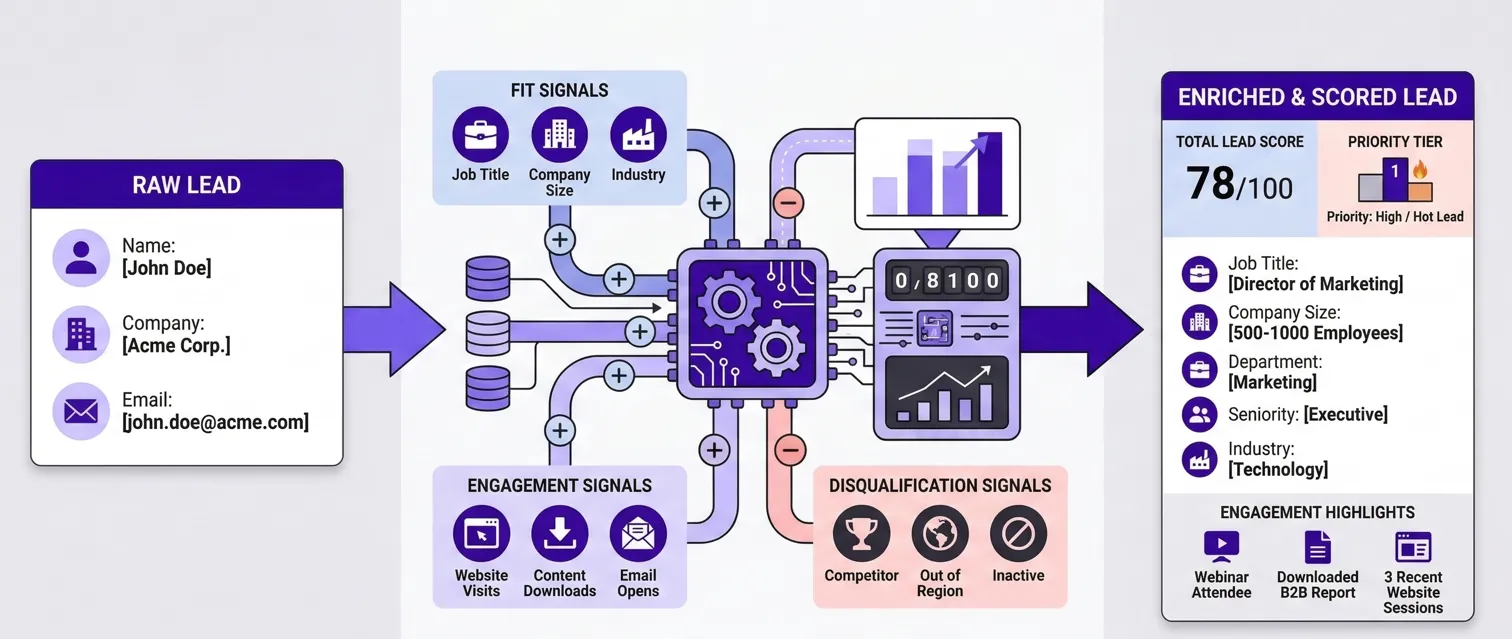

Lead scoring is the process of assigning a numeric value to each prospect based on their firmographic profile, behavioral signals, and engagement history. It's how sales and marketing teams figure out who's actually worth calling and who's just browsing.
Here's the stat that matters: according to MarketOne, 68% of highly successful marketers cite lead scoring as the top driver behind improved revenue contribution. Aberdeen Group research backs this up, finding that companies using lead scoring see 18% shorter sales cycles on average compared to teams running on gut instinct.
If you're running outbound at scale with tools like HubSpot, Salesforce, or any CRM-based pipeline, you already have the raw data. Lead scoring turns that data into a priority list your SDRs can actually use.
In 2026, a well-built lead scoring model feeds directly into MQL-to-SQL handoffs, pipeline forecasting, ABM targeting, SDR prioritization, and predictive analytics. This guide covers how to build one that works.
🎯 TLDR:
Lead scoring assigns a numeric value to each lead based on fit (who they are) and engagement (what they've done)
The four data categories: demographic, firmographic, behavioral, and disqualification signals
68% of top marketers say lead scoring drives their revenue contribution (MarketOne)
Companies using lead scoring see 18% shorter sales cycles (Aberdeen Group)
Build your model in 6 steps: define ICP, map behavioral patterns, weight by conversion data, set baselines, compare close rates, set routing thresholds
The #1 mistake? Building a scoring model on incomplete CRM data. Contact data enrichment with tools like FullEnrich fixes this before scores are calculated
Review your model quarterly. Rebuild it fully at least once per year
What Is Lead Scoring and Why Does It Matter?
Lead scoring is the process of assigning a numeric value to a prospect based on two things: how closely they match your ideal customer profile and how actively they've engaged with your business.
The resulting score tells sales and marketing teams which leads deserve immediate attention, which need nurturing, and which should be deprioritized entirely.
Think about it this way. A contact who's a VP of Sales at a 200-person SaaS company, has visited your pricing page three times, downloaded a comparison guide, and attended a product webinar?
That's a very different level of intent than someone who signed up for a newsletter once and never came back. Lead scoring makes that difference visible at a glance.
It sits at the intersection of CRM hygiene, contact data enrichment, sales qualification, and marketing automation. Without it, your SDRs are sorting through an unsorted pile of names in Salesforce or HubSpot, guessing who to call first.
Lead scoring uses two categories of signals:
Fit signals measure how closely a lead matches your ICP based on job title, company size, industry, and geography
Engagement signals measure how actively a lead interacts with your content, emails, website, and sales touchpoints
The most effective scoring models in tools like HubSpot, Marketo, and Salesforce Pardot combine both. A lead who fits perfectly but hasn't engaged needs nurturing.
A lead who engages constantly but doesn't fit your ICP is a time sink. You need both dimensions to score accurately.
What Data Types Drive a Lead Scoring Model?
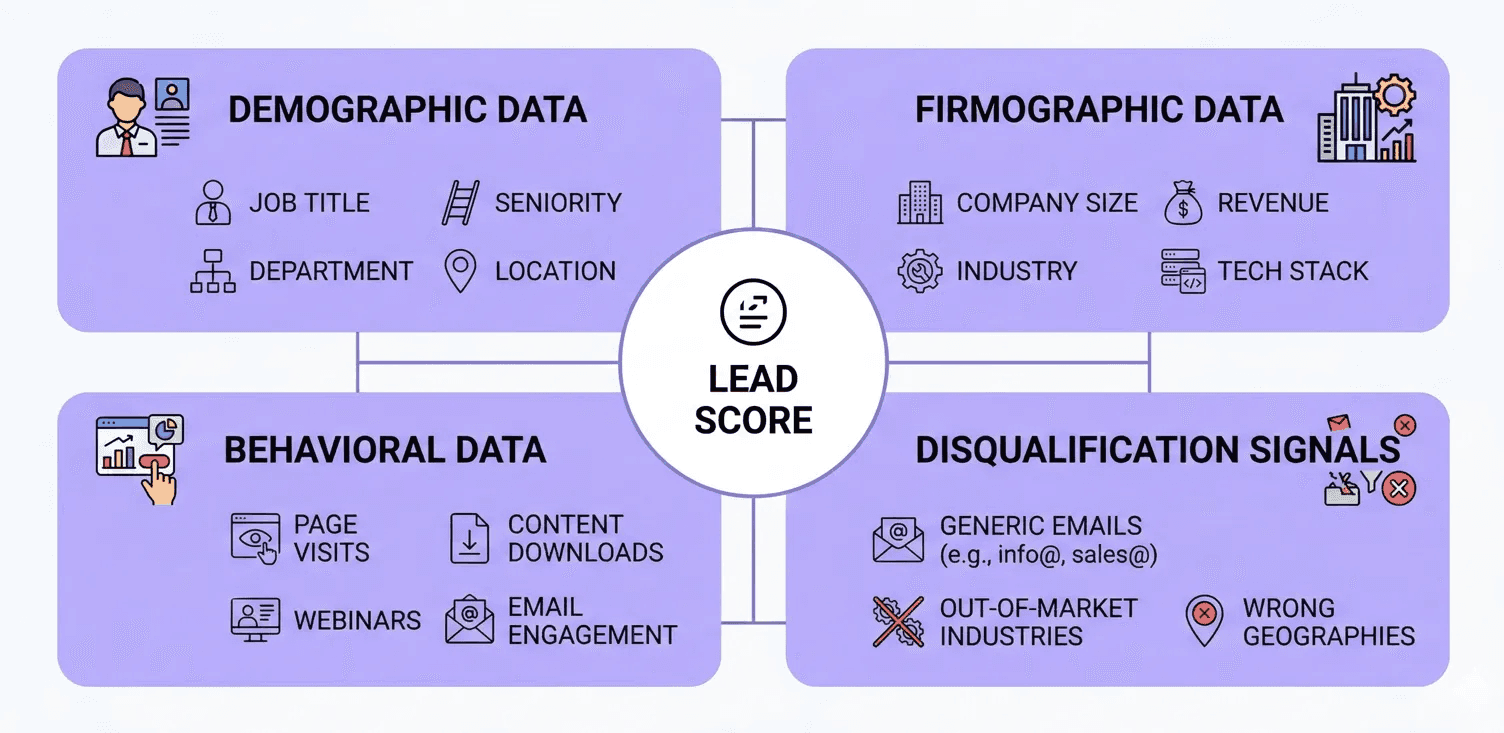
Lead scoring models draw from four categories of data, each capturing a different dimension of prospect quality. Understanding the role of each helps teams build models that reflect real conversion patterns rather than assumptions.
Demographic Data
Demographic data describes who the lead is as an individual. Job title, seniority level, department, years of experience, and location all fall into this category.
A Director of Revenue Operations at a 300-person tech company scores higher on most B2B scoring models than an intern at the same company. The reason is straightforward: the director is closer to the buying decision.
If you're selling to RevOps or Sales leaders, seniority weighting is one of your highest-impact scoring levers.
Firmographic Data
Firmographic data describes the lead's organization. Company size, annual revenue, industry vertical, technology stack, funding stage, and growth rate determine whether a company fits the profile of accounts that typically convert.
A seed-stage startup with five employees is a fundamentally different prospect than a Series C company with 400 people, even if the contact titles are identical.
This is where tools like Apollo, ZoomInfo, Clearbit, and FullEnrich earn their keep by filling in the firmographic fields your scoring model needs.
Behavioral Data
Behavioral data captures what the lead has actually done in their interactions with your business. Not all actions carry equal weight. Visiting the pricing page signals more intent than visiting the homepage. Requesting a demo outweighs downloading a top-of-funnel ebook.
The two primary behavioral categories are:
Email engagement: opens, clicks, replies
On-site engagement: page visits, time on page, form completions, content downloads, webinar attendance
If someone attends your product webinar, opens three emails in a week, and then hits the pricing page? That sequence is worth 5x more than a single blog visit. Your scoring model should reflect that.
Disqualification Signals
Disqualification signals represent a fourth category most teams underweight. Leads who use generic email addresses (info@, sales@) on gated content, who work in industries outside your serviceable market, or who are located in regions where you don't operate should receive negative scores that reduce their priority rank.
Here's the thing: without disqualification signals, your model only adds points. That means competitor researchers, students, and perpetual content consumers can all rack up high scores without ever having genuine purchase intent.
Negative scoring criteria save the sales team from chasing leads that will never convert regardless of engagement level.
How Do You Build a Lead Scoring Model in 6 Steps?
Building a lead scoring model requires a structured process grounded in actual conversion data, not assumptions about what should matter. Here's how to do it.
Step 1: Define Your Ideal Customer Profile
Before assigning any points, identify the firmographic and demographic characteristics of accounts and contacts most likely to convert. Pull your closed-won deals from Salesforce or HubSpot and analyze the patterns.
Which industries, company sizes, job titles, and geographies show up most frequently? That pattern becomes the foundation of your fit scoring criteria.
Step 2: Identify Behavioral Patterns Among Converted Leads
Pull historical data on leads that became customers and map the actions they took before converting. Did they visit the pricing page more than twice? Did they attend a live demo? Did they engage with email sequences within 48 hours?
These behavioral touchpoints become the basis of your engagement scoring criteria.
Don't guess here. Let the data tell you what converted leads actually did.
Step 3: Assign Point Values Weighted by Conversion Correlation
Not all attributes and actions carry equal predictive weight. A contact who requests a product demo has a meaningfully higher conversion probability than one who clicks a single email.
Assign higher point values to signals that correlate most strongly with conversion in your historical data. A typical range uses a 0 to 100 scale:
🎯 High-intent actions like demo requests: 20 to 30 points
✅ Mid-intent actions like webinar attendance or pricing page visits: 10 to 15 points
Newsletter opens and single email clicks: 1 to 3 points
Step 4: Calculate Your Baseline Lead-to-Customer Conversion Rate
Divide the number of new customers acquired in a period by the total number of leads generated in the same period. If you acquired 60 customers from 400 leads, your conversion rate is 15%.
This baseline becomes your reference point for calibrating point values across every attribute.
Step 5: Compare Attribute-Specific Close Rates Against the Baseline
For each attribute or action in your model, calculate how many leads with that characteristic actually converted.
If leads who attended a product webinar convert at 40% while your baseline is 15%, webinar attendance deserves a significantly higher point value reflecting that elevated probability.
Attributes with below-baseline conversion rates should receive zero or negative points. This is where data-driven scoring separates itself from guessing.
Step 6: Establish Score Thresholds for Routing and Action
Once the scoring model is live, define what score ranges mean operationally:
70 to 100: Route directly to an SDR for immediate outreach
40 to 69: Enter a nurture sequence
Below 40: Stay in a long-term marketing flow until engagement increases
These thresholds connect the scoring model to the actual sales workflow. Without them, you have scores but no action. The point of scoring is to trigger the right next step.
What Are the Main Lead Scoring Models?
Different business contexts require different scoring approaches. The three most common models reflect different data priorities and team structures.
The B2B Firmographic Model
The B2B firmographic model prioritizes company-level attributes over individual behavior. It's most useful for teams selling to specific segments defined by company size, industry, or technology.
If your product only delivers value to companies with 50 or more employees using Salesforce, then every lead from a five-person company on HubSpot should score near zero regardless of how many emails they've opened. Firmographic fit is a gatekeeper.
The Behavioral Engagement Model
The behavioral engagement model prioritizes actions over identity. It's most useful for teams with broad ICP definitions where intent signals matter more than demographic fit.
This model assigns points for email opens, clicks, replies, and form completions. It subtracts points for unsubscribes and extended periods of inactivity.
If you're running high-volume inbound and your ICP is broad, behavioral scoring surfaces the hottest leads from the noise.
The Combined Fit and Engagement Model
The combined fit and engagement model scores both dimensions simultaneously. HubSpot's scoring system uses letter grades for fit (A, B, C) and number grades for engagement (1, 2, 3), resulting in categories like:
A1 = high fit, high engagement = Hot Lead
B2 = medium fit, medium engagement = Nurture
C3 = low fit, low engagement = Disqualified
This matrix format gives sales and marketing teams a shared language for lead quality. It surfaces contacts most likely to convert and deprioritizes contacts that are engaged but structurally unqualified.
For most B2B teams running outbound with Salesforce, HubSpot, or Marketo, the combined model is the right starting point. It's the only approach that catches both dimensions of lead quality.
Why Is Enriched Contact Data the Foundation of Accurate Lead Scoring?
A lead scoring model is only as accurate as the data feeding it. Full stop.
If a contact record is missing a job title, the fit scoring model can't evaluate that attribute. If the company size field is blank or outdated, firmographic scoring applies incorrect weights.
If the email address is invalid, engagement signals never generate. In each case, the lead receives an artificially low score, not because they're a poor prospect, but because their record is incomplete.
This is the exact problem that contact data enrichment solves. When a lead fills out a form with only a name and email address, enrichment tools like FullEnrich, Apollo, ZoomInfo, Clearbit, or Lusha automatically append job title, company name, company size, industry, and LinkedIn data before the record enters your scoring model.
The model then evaluates a complete profile rather than a partial one.
The connection for RevOps teams is direct: incomplete records produce inaccurate scores. Inaccurate scores misdirect SDR time. Misdirected SDR time reduces pipeline velocity and quota attainment.
Solving for data completeness at the point of enrichment is the most structurally sound way to protect the integrity of a lead scoring system over time.
How Does FullEnrich Keep Lead Scoring Data Accurate?
FullEnrich is a waterfall enrichment platform that aggregates 20+ premium data providers, including Apollo, Lusha, ZoomInfo, Hunter, and Datagma, and sequences queries through them until it finds and verifies a contact's email, phone, and firmographic data.
When a raw contact record enters a workflow, FullEnrich populates the fields that lead scoring models depend on: job title, company name, company size, industry, seniority level, and LinkedIn profile data.
The result is that every lead entering the scoring model arrives with complete fields. Scores reflect actual fit and engagement rather than defaulting to zero because a company size field was empty.
For teams enriching inbound form fills in real time, this closes the gap between an incomplete record and an accurate score before any human ever reviews the lead. That's the difference between your SDR calling the best lead in the queue and wasting 20 minutes on a record that scored low because data was missing.
FullEnrich's credit model supports this economically. A credit is only consumed when enrichment returns a verified result, which makes enriching every inbound lead predictable in cost regardless of volume.
Native integrations with HubSpot, Salesforce, Zapier, Make, and Google Sheets mean enrichment runs automatically within existing CRM and scoring workflows without engineering overhead.
What Are the Most Common Lead Scoring Mistakes That Break Pipeline?
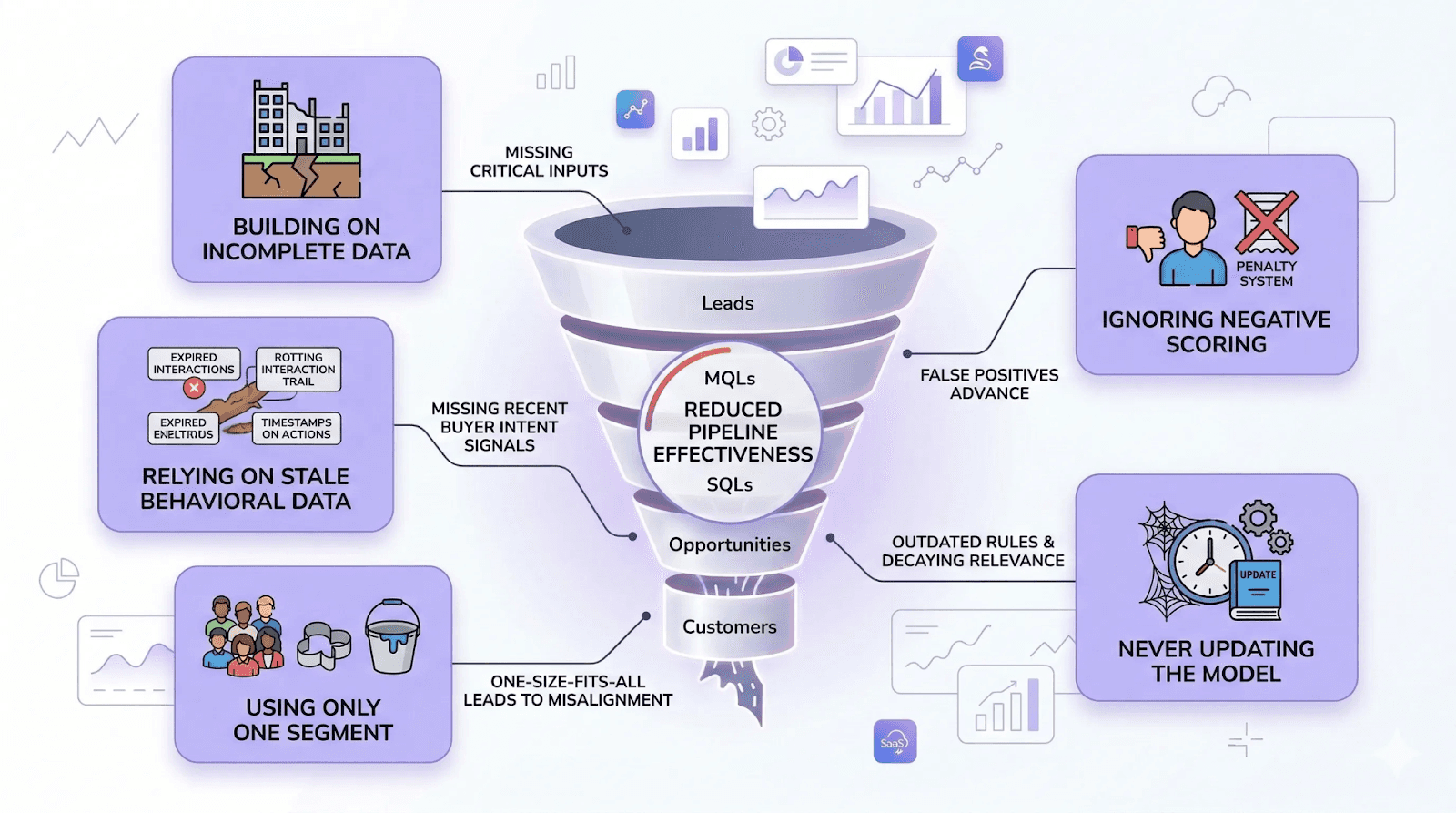
You can build a scoring model with the right structure and still break your pipeline if you fall into these traps.
Building on Incomplete Data
A scoring model built on CRM records that are 30 to 40% incomplete produces scores that reflect data absence rather than prospect quality. Enriching records before scoring begins isn't optional. It's the prerequisite. If your Salesforce instance has blank fields on a third of your contacts, your scores are fiction.
Ignoring Negative Scoring
A model that only adds points will gradually accumulate leads at the top of the scoring range who have no genuine purchase intent. Competitor researchers, students, and perpetual content consumers all reach high scores without ever becoming buyers.
The fix: negative scoring criteria for disqualifying attributes. Generic email domains, out-of-market industries, wrong geographies. These counteract score inflation before it becomes a pipeline problem.
Never Updating the Model
Customer profiles change. New market segments emerge. A scoring model that was accurate 18 months ago may actively mislead the sales team today if it hasn't been revised to reflect a product repositioning, a new market entry, or a shift in win rate patterns.
Most practitioners recommend reviewing scoring criteria every quarter and rebuilding the model fully at least once per year.
Using Only One Segment
A single scoring model rarely serves all the product lines, regions, or buyer personas a growing B2B company addresses. A team selling both to enterprise RevOps buyers and to startup founders needs different scoring criteria for each segment.
Using a single model for both introduces noise that reduces accuracy for everyone. If you sell to two distinct personas, build two models.
Relying on Stale Behavioral Data Without Decay
Engagement signals without decay logic accumulate indefinitely. A lead who downloaded an ebook two years ago still carries those points, even though their interest is long gone.
Score decay ensures the model reflects current interest, not historical interest. Most teams implement a decay factor that reduces behavioral scores by 10 to 20% per month of inactivity, though the right rate depends on your sales cycle length.
Conclusion
Lead scoring works when three things are true: the model reflects real conversion patterns, the data feeding it is complete and current, and the thresholds connecting scores to workflow actions are agreed upon by both sales and marketing.
Here's what to remember:
According to MarketOne, 68% of highly successful marketers cite lead scoring as the top driver of revenue contribution
Aberdeen Group found that companies using lead scoring see 18% shorter sales cycles
A scoring model built on incomplete CRM records produces misdirection, not prioritization. Tools like FullEnrich, Apollo, ZoomInfo, and Clearbit solve this by enriching records before the model evaluates them
Negative scoring prevents pipeline inflation from unqualified but engaged contacts
The combined fit + engagement model (used in HubSpot, Marketo, and Salesforce Pardot) is the most reliable approach for B2B teams
The foundational investment isn't in the scoring logic itself. It's in the data quality that makes the scoring logic reliable. For B2B teams running outbound at scale, that means connecting their CRM to an enrichment layer that fills in the firmographic and contact fields the scoring model depends on before the model ever evaluates the record.
When enrichment and scoring operate as a connected system, the lead at the top of an SDR's queue isn't just the most engaged contact. It's the most qualified, most complete, and most accurately evaluated prospect in the pipeline.
See how FullEnrich helps B2B teams enrich leads at scale →
FAQs
What Is a Good Lead Score Threshold for Routing to Sales?
A common starting point for B2B teams is routing leads above 60 to 70 (on a 100-point scale) to active SDR outreach. Leads between 30 and 59 enter nurture sequences. The key is calibrating thresholds against your actual close rates in Salesforce or HubSpot, not industry averages.
How Often Should a Lead Scoring Model Be Updated?
Most practitioners recommend reviewing scoring criteria every quarter and rebuilding the model fully at least once per year. When a company launches a new product, enters a new market, or experiences a significant shift in win rate, the model should be re-evaluated sooner regardless of the calendar.
Does Lead Scoring Work for Small B2B Teams?
Yes, but simplicity scales better than sophistication at early stages. A small team with 500 leads benefits more from a 5-attribute manual scoring model consistently applied than from a complex predictive system built on insufficient data.
Start with the 3 to 5 attributes that most reliably distinguish your best customers from the rest. Build complexity only as your dataset grows.
What Happens to Lead Scores When Contact Data Is Missing?
Missing fields produce default zero scores for the affected attributes. This drags the lead's total score down regardless of engagement signals.
This is why contact data enrichment and lead scoring should be treated as a connected system. Enriched records (via tools like FullEnrich, Apollo, or ZoomInfo) produce accurate scores. Incomplete records produce artificially low scores that misdirect sales effort.
How Does Predictive Lead Scoring Differ from Rule-Based Scoring?
Rule-based scoring uses manually defined criteria and point values set by a human. Predictive scoring uses machine learning to identify which attributes and behaviors actually correlate with conversion in your historical data.
Predictive models typically outperform rule-based models in accuracy, but they require a minimum dataset of several hundred conversions to produce reliable outputs. Tools like Salesforce Einstein, HubSpot Predictive Lead Scoring, and MadKudu offer built-in predictive scoring for teams with enough data to support it.
Happy scoring! 🎯



Other Articles
Cost Per Opportunity (CPO): A Comprehensive Guide for Businesses
Discover how Cost Per Opportunity (CPO) acts as a key performance indicator in business strategy, offering insights into marketing and sales effectiveness.
Cost Per Sale Uncovered: Efficiency, Calculation, and Optimization in Digital Advertising
Explore Cost Per Sale (CPS) in digital advertising, its calculation and optimization for efficient ad strategies and increased profitability.
Customer Segmentation: Essential Guide for Effective Business Strategies
Discover how Customer Segmentation can drive your business strategy. Learn key concepts, benefits, and practical application tips.