

Profile enrichment is the automated process of appending verified, high-quality data to a basic contact record. A raw record containing a name, company, and LinkedIn URL becomes a complete, actionable profile with work email, mobile phone, firmographic details, technographic signals, and behavioral context.
It draws on waterfall enrichment models, multi-source data providers, CRM hygiene workflows, and real-time validation to give B2B sales, marketing, RevOps, and recruiting teams the contact intelligence they need without manual research.
What Is Profile Enrichment and Why It's Important in 2026?
Profile enrichment is the automated process of enhancing a basic contact or company record with additional verified data pulled from external sources. A raw record might contain a name, a company name, and a LinkedIn URL.
An enriched profile adds work email, personal email, mobile number, job title, seniority level, department, company headcount, revenue range, industry, technology stack, and more.
Profile enrichment has become the need of the hour due to three converging pressures.
First, sales reps spend up to 40% of their time searching for contacts to call, which is time not spent selling.
Second, email deliverability has gotten harder: inbox providers begin flagging senders whose bounce rates exceed 2%, and recovery takes months.
Third, outbound personalization has become a baseline expectation. A rep who reaches out without knowing a prospect's role, company size, or industry signals immediately that they have not done their homework.
Profile enrichment addresses all three at once. It eliminates the research bottleneck, reduces bounce rates by validating emails before they are sent, and provides the context needed to personalize outreach at the first touch.
How Does Profile Enrichment Work? The Waterfall Enrichment Model Explained
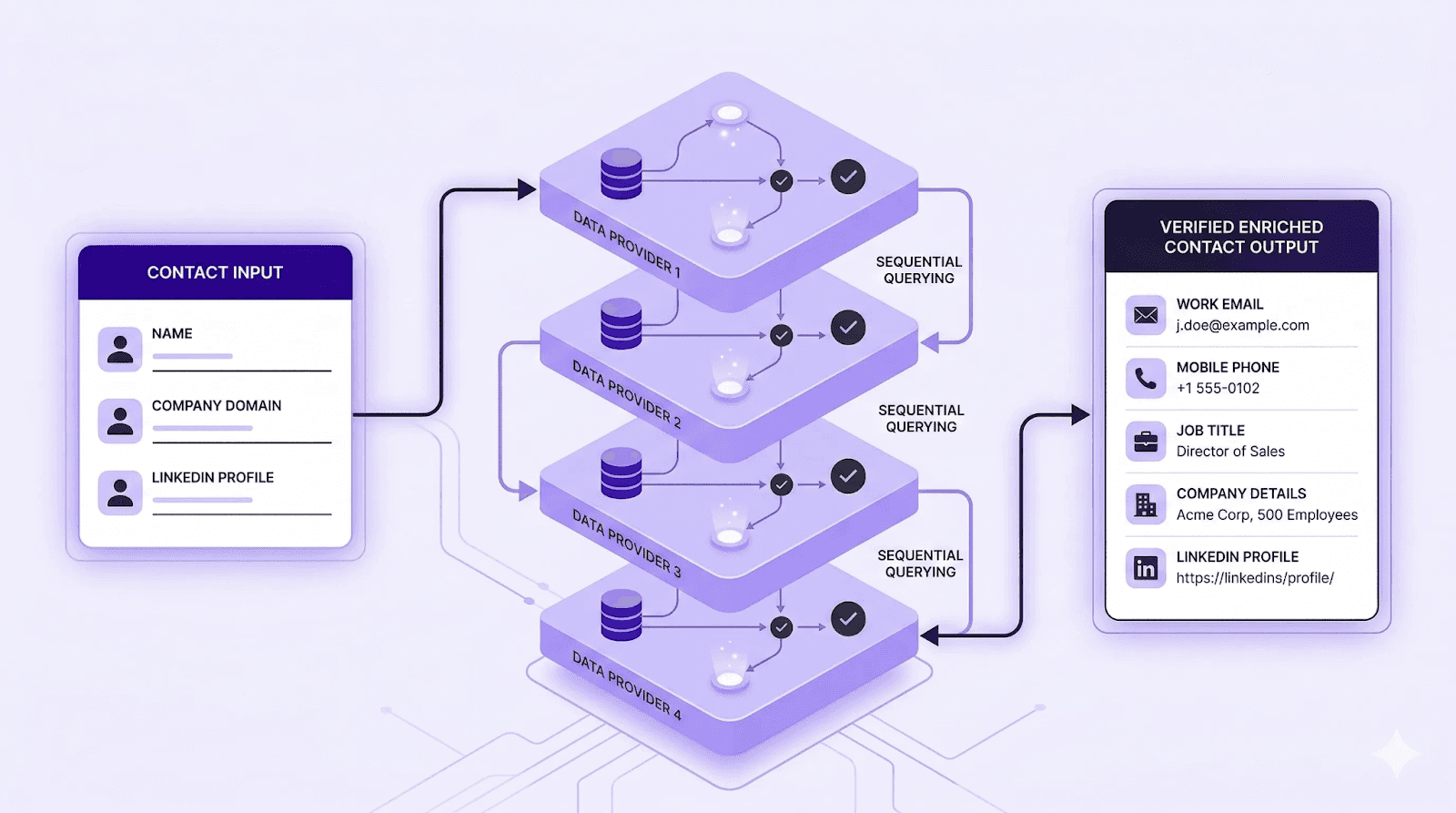
Profile enrichment systems follow a sequential process: they take a raw input, query one or more data sources, validate what they find, and return a completed record. The difference between platforms lies in how many sources they query and in what order.
Single-source enrichment tools query one proprietary database. If that database has the record, you get it. If it does not, you get nothing and may still pay for the query. This is the model used by the majority of contact data platforms on the market today.
Waterfall enrichment takes a different approach. Instead of relying on a single source, it queries multiple data providers in sequence until it finds a verified result. This matters because no single provider covers every prospect. A provider with strong US coverage may have weak data in EMEA.
A provider that excels at finding work emails may have limited mobile phone data. By layering providers sequentially, waterfall enrichment dramatically increases the probability of finding a valid contact on any given record, producing measurably higher match rates across geographies, industries, and company sizes.
What Happens During the Enrichment Process: Step by Step
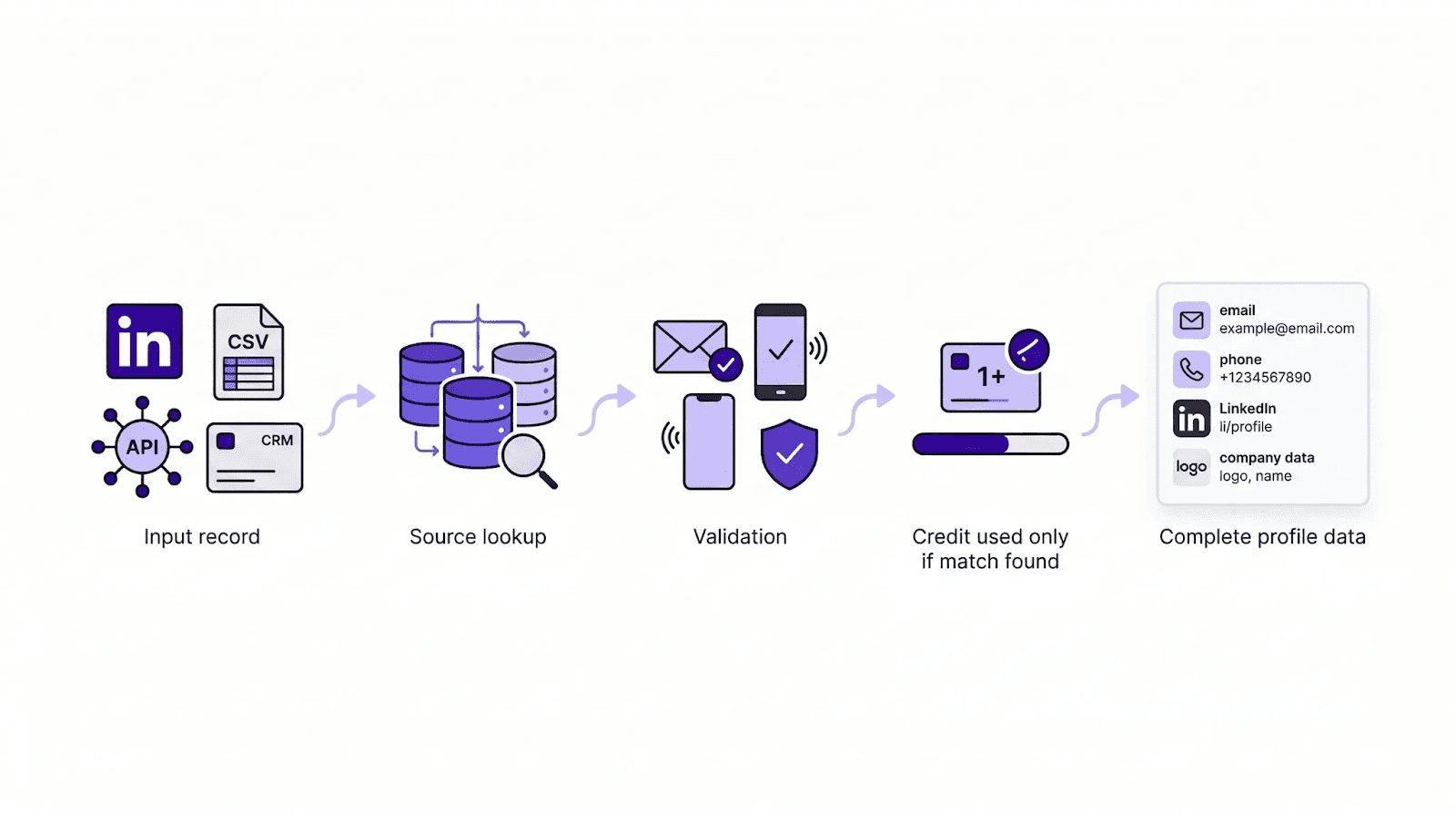
Understanding what happens when a profile enrichment request fires helps teams build better workflows and set accurate expectations.
Step 1: Input submission. A user submits a record containing a prospect's name and company domain, a LinkedIn URL, a CSV file, or triggers an API call from a CRM. Multiple input types are supported, including reverse email lookup via API.
Step 2: Source sequencing. The waterfall engine begins querying its stack of data providers in order of relevance and coverage quality for that specific record type.
Step 3: Real-time validation. When a candidate email is found, it goes through a triple verification process to confirm deliverability. Phone numbers are cross-referenced against carrier databases to confirm they belong to the named individual.
Step 4: Credit allocation. A credit is only consumed when the enrichment succeeds and returns a verified result. If no valid contact is found, no credit is charged.
Step 5: Data delivery. The enriched profile is returned with the combination of outputs found: work email, personal email, mobile phone, LinkedIn job title, LinkedIn profile URL, company name, company description, website, industry, company type, date established, headcount, and company LinkedIn URL.
Who Uses Profile Enrichment and What Problem Does It Solve?
Profile enrichment is used differently across a B2B organization, but the core problem it solves is the same: incomplete data that slows down outreach and reduces pipeline quality.
SDRs and BDRs use it to build verified contact lists without spending hours on LinkedIn. A rep who previously spent 90 minutes building a list of 50 contacts can upload a CSV and return to a fully enriched file in minutes. That reclaimed time goes directly into outreach activity.
Sales managers and VPs use it to maintain pipeline quality. When CRM records are enriched automatically on inbound form fills or when new contacts are added, reps spend less time on admin and more time on active opportunities.
Demand generation and marketing teams use it to fix incomplete inbound leads. A prospect who fills out a demo request often provides only a name and email. Enriching that record adds job title, company size, industry, and seniority, enabling proper lead scoring, routing, and personalized follow-up sequences.
RevOps and SalesOps teams use it to maintain CRM hygiene at scale. Automated enrichment through API or integration keeps records current without manual intervention, which matters when job titles change, emails expire, and phone numbers disconnect regularly.
Recruiters use it to reach passive candidates who will not respond to a LinkedIn InMail. A personal email or direct mobile number for a strong candidate dramatically increases response rates.
Startup founders use it to skip toolstack complexity. Instead of subscribing to multiple data providers and managing separate APIs, a single waterfall platform handles coverage from multiple sources under one contract.
What Data Sources Drive Profile Enrichment?
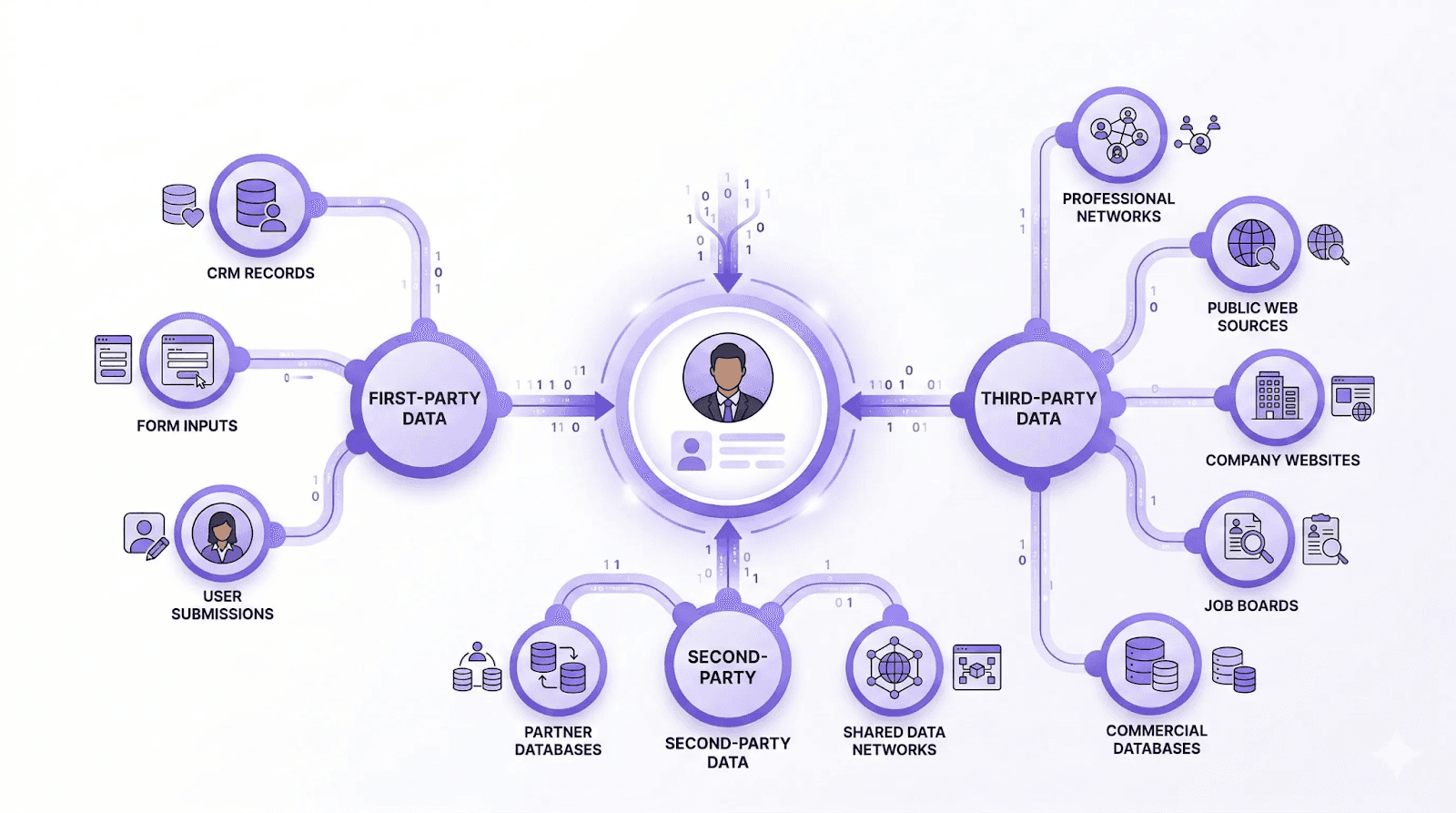
The quality of enriched profiles depends entirely on the quality and diversity of underlying data sources. Profile enrichment platforms draw from three categories:
first-party data from direct user inputs and owned properties
second-party data from partner agreements and shared databases
third-party data from public web sources, professional networks, commercial databases, and proprietary provider networks.
For B2B contact enrichment, the most critical sources are those that surface verified work emails, personal emails, and direct mobile numbers.
Professional networks provide foundational employee data including job titles and career history. Job postings reveal hiring intent and technology adoption signals. Company websites and business directories contribute firmographic details.
No single source covers every market segment, company size, or geography with equal depth. A provider that performs well for US-based SaaS companies may perform poorly for manufacturing firms in Germany or mid-size service companies in Southeast Asia. Stacking providers in a waterfall ensures that coverage gaps in one source are filled by strength in another.
Profile Enrichment for CRM Hygiene: How to Keep Your Data Clean at Scale?
One of the most undervalued applications of profile enrichment is CRM hygiene. Job titles change when people get promoted or switch companies. Email addresses expire when someone leaves a role.
Phone numbers disconnect. Over time, a CRM that was clean at implementation drifts into a collection of outdated records that actively misleads the teams relying on it.
Manual CRM cleanup is not scalable. Assigning a RevOps analyst to audit and update records one by one costs hundreds of hours per quarter and produces inconsistent results.
Automated profile enrichment solves this through integration. When a contact enters the CRM, enrichment runs immediately. When a deal reaches a certain stage, enrichment can re-verify contact data before the rep reaches out. Scheduled bulk enrichment can run quarterly to catch records that have drifted since they were last updated.
For RevOps teams evaluating enrichment tools, the key questions are: does the tool enrich in real time or only in batch? Does it support bi-directional CRM sync? Does it flag records it cannot enrich rather than silently returning empty fields? And does it verify that the contact information returned belongs to the named individual?
Profile Enrichment vs. Related Concepts: What Is the Difference?
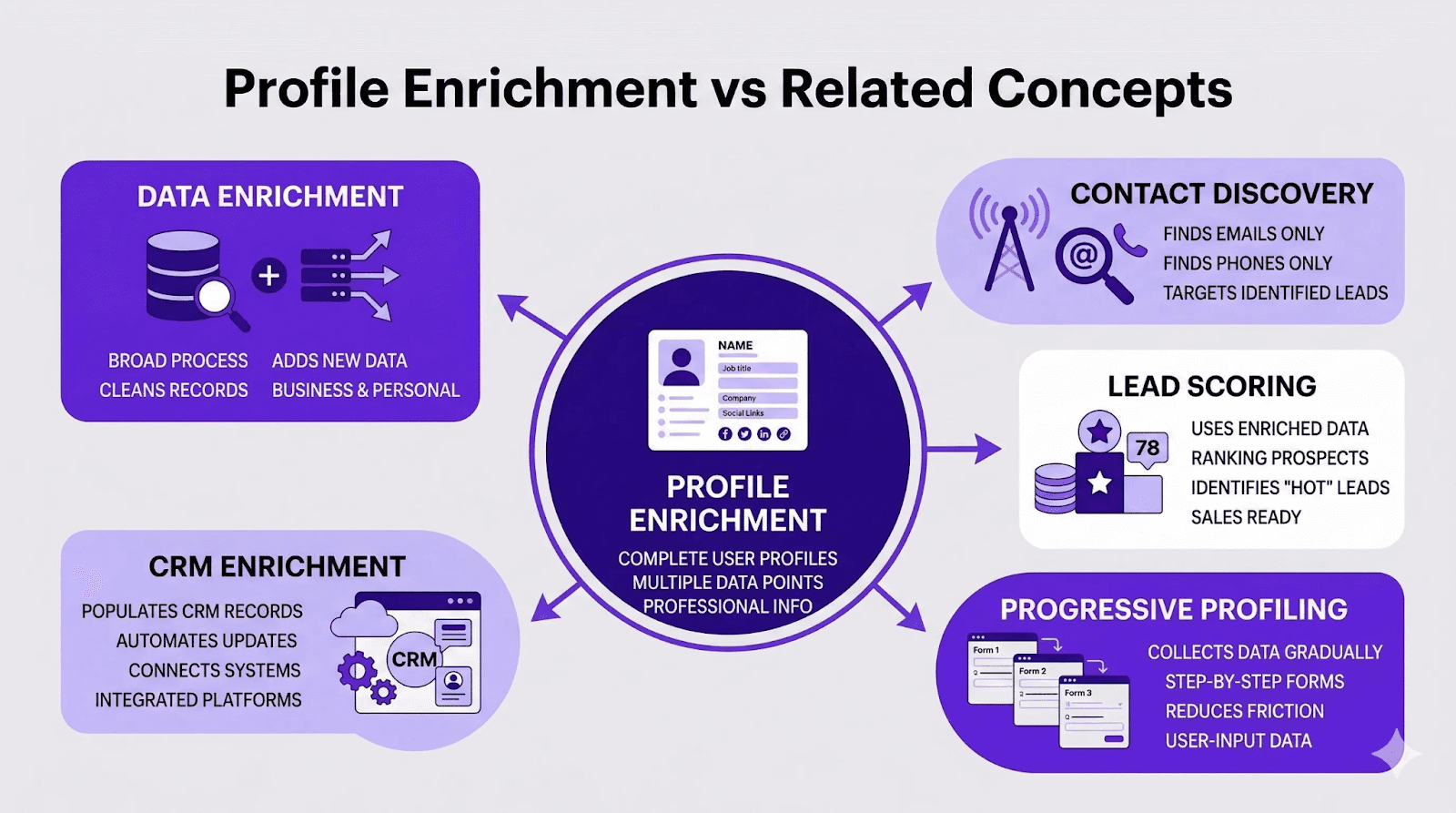
Profile enrichment sits at the intersection of several overlapping categories.
Profile enrichment vs. data enrichment. Data enrichment is the broader term covering any process of appending external data to a record, whether a contact, company, product, or transaction. Profile enrichment refers specifically to individual person or company profiles. All profile enrichment is data enrichment, but not all data enrichment is profile enrichment.
Profile enrichment vs. contact discovery. Contact discovery finds a specific email or phone number for a named individual. Profile enrichment goes further by building the complete professional context around that contact, including company, role, seniority, firmographics, and technographics.
Profile enrichment vs. lead scoring. Lead scoring assigns a numeric value to a prospect based on fit and behavior. Profile enrichment provides the underlying data that feeds into a lead scoring model. Without enriched firmographic and professional data, lead scoring models operate on incomplete inputs.
Profile enrichment vs. progressive profiling. Progressive profiling collects additional data from users gradually over multiple touchpoints. Profile enrichment pulls that data automatically from external sources without requiring user input. Both build more complete profiles, but through entirely different mechanisms.
Profile enrichment vs. CRM enrichment. CRM enrichment is a specific application of profile enrichment, referring to the use of enrichment to populate or update records within a CRM. Profile enrichment is the broader capability; CRM enrichment is one delivery channel for it.
Common Mistakes That Make Profile Enrichment Fail
Following are some of the common mistakes that make profile enrichment fail:
Relying on a single data source: No single provider covers every prospect with equal depth. Teams dependent on one database consistently hit coverage gaps in certain geographies, industries, or company sizes, producing a list that is 60 to 70 percent enriched with the hardest-to-find contacts systematically missing.
Treating enrichment as a one-time project. Data decays continuously. An email valid six months ago may now bounce. Teams that run a single enrichment pass and never refresh find list quality degrading steadily. Enrichment should be continuous, not periodic.
Paying for failed enrichment attempts: Several platforms charge a credit regardless of whether a valid result is returned. Over a large volume of records, the cost of failed attempts compounds quickly. The most cost-effective model only charges on successful enrichment.
Skipping validation: Finding an email address is not the same as finding a verified email address. Without deliverability validation, enriched lists contain addresses that look correct but will bounce on send. Triple verification on every email, and carrier matching on every phone number, are non-negotiable for protecting sender reputation.
Ignoring compliance requirements: GDPR, CCPA, and other data privacy regulations impose specific requirements on how contact data is collected, stored, and used. Platforms that store personal data in a central database raise questions about data residency and consent. On-demand data fetching, where data is retrieved but not stored, aligns with GDPR's principle of data minimization and reduces compliance risk.
Adding per-seat licensing costs: Many enrichment platforms charge per user seat, creating a hidden cost that scales with team size. For a sales org of 20 reps, seat fees can equal or exceed the cost of the credits themselves.
How FullEnrich Approaches Profile Enrichment?
FullEnrich uses a waterfall enrichment model that aggregates 20+ premium data providers, including Apollo, Lusha, ZoomInfo, Hunter, Datagma, and ContactOut, and sequences through them until it finds a verified result. This produces an overall find rate above 80%, with regional rates of 89% for email and 86% for phone in the US and Canada, 84% and 71% in EMEA, 78% and 67% in LATAM, and 78% and 66% in APAC.
Every email returned passes through triple verification against mail server records, keeping bounce rates under 1%. Phone numbers are matched against carrier databases to confirm they belong to the named individual. Data is fetched on demand rather than stored, which aligns with GDPR's data minimization principle and eliminates the compliance risks associated with static personal data storage.
FullEnrich is credit-based, charging only on successful enrichment. Unlimited user seats are included on all plans, so teams share a single credit pool without per-head licensing fees. Credits charged on annual plans roll over for the full year, and top-up credits are available for teams that exceed their monthly allocation.
Supported input types include name plus company name or domain, LinkedIn profile URL, CSV or Excel upload, and API integration. Reverse email lookup is available through the API. Native integrations cover HubSpot, Salesforce, Zapier, Make, and Google Sheets for teams that want enrichment embedded directly into their CRM or automation workflows.
How to Evaluate a Profile Enrichment Tool?
Match rate and coverage: Request a coverage test against a sample of your actual ICP before committing. A vendor whose headline match rate looks strong may perform poorly against your specific industry, geography, or company size. Test both email and phone enrichment, and ask how results are validated.
Data freshness: Ask how frequently underlying data sources are updated. Platforms that fetch data on demand tend to return fresher results than those serving from a static cache.
Pricing transparency: Understand exactly what triggers a credit charge. Does a partial result consume a credit? Does a failed enrichment cost something? Are there per-seat charges on top of credits? Models that only charge on successful enrichment are significantly more cost-effective at scale.
Integration depth: Check whether the tool integrates natively with your CRM, sales engagement platform, and automation stack. API access and Zapier compatibility extend coverage to custom setups.
Compliance posture: Confirm SOC 2 certification, GDPR compliance, and CCPA compliance. Understand whether the platform stores personal data or fetches on demand. For teams handling EU-based prospect data, this distinction is material.
Enrichment inputs supported: Confirm which input formats are supported: name plus company domain, LinkedIn URL, CSV bulk upload, and API integration at minimum. Reverse email lookup via API is valuable for deduplication and inbound enrichment workflows.
Conclusion
Profile enrichment is the automated process of appending verified professional, firmographic, and contact data to a raw record using external sources. In 2026, it is a foundational capability for B2B sales, marketing, RevOps, and recruiting teams that need to build pipeline efficiently without manual research bottlenecks.
The waterfall enrichment model delivers higher match rates than single-source tools by sequencing queries across multiple providers until a verified result is found. Effective enrichment reduces bounce rates, eliminates manual research time, feeds accurate inputs into lead scoring and ABM models, and maintains CRM hygiene at scale.
Teams that treat enrichment as a continuous process rather than a one-time project sustain data quality over time and compound the pipeline benefits quarter over quarter.
See how FullEnrich's waterfall model improves your contact find rates
FAQs
What is profile enrichment and how does it improve email deliverability?
Profile enrichment improves email deliverability by replacing unverified or outdated email addresses with validated contacts before an outbound sequence begins. Industry benchmarks set the acceptable bounce rate threshold at below 2%, and recovery from crossing it takes months. Triple-verified emails keep bounce rates under 1%, protecting sender reputation and inbox placement over time.
Is profile enrichment GDPR compliant?
Profile enrichment can be GDPR compliant depending on how a platform handles personal data. Platforms that store static contact databases may raise concerns about consent, data residency, and the right to erasure. Platforms that fetch data on demand reduce these risks significantly by aligning with GDPR's data minimization principle.
How many data sources should a profile enrichment tool use?
Reliable profile enrichment tools use 10 or more data providers to ensure strong coverage across industries and regions. Single-source tools create systematic coverage gaps, particularly for mobile phone numbers, personal emails, and international contacts. Waterfall enrichment with 20+ providers fills these gaps by sequencing through sources until a verified result is found.
What is the difference between bulk enrichment and real-time enrichment?
Bulk enrichment processes a large list at once, usually from a CSV or CRM export, and is used to clean databases or prepare campaign lists. Real-time enrichment processes a single record instantly when it enters a workflow, such as when a prospect submits a form or a rep adds a contact to a CRM. The most capable platforms support both.
How does profile enrichment support account-based marketing?
Profile enrichment supports ABM by providing accurate firmographic and contact data for target accounts: verified emails and phones for stakeholders, job titles and seniority for identifying decision-makers, company headcount and revenue for prioritization, and technographic signals for personalized messaging. Without enriched profiles, ABM campaigns reach the wrong contacts with generic messaging.



Other Articles
Cost Per Opportunity (CPO): A Comprehensive Guide for Businesses
Discover how Cost Per Opportunity (CPO) acts as a key performance indicator in business strategy, offering insights into marketing and sales effectiveness.
Cost Per Sale Uncovered: Efficiency, Calculation, and Optimization in Digital Advertising
Explore Cost Per Sale (CPS) in digital advertising, its calculation and optimization for efficient ad strategies and increased profitability.
Customer Segmentation: Essential Guide for Effective Business Strategies
Discover how Customer Segmentation can drive your business strategy. Learn key concepts, benefits, and practical application tips.